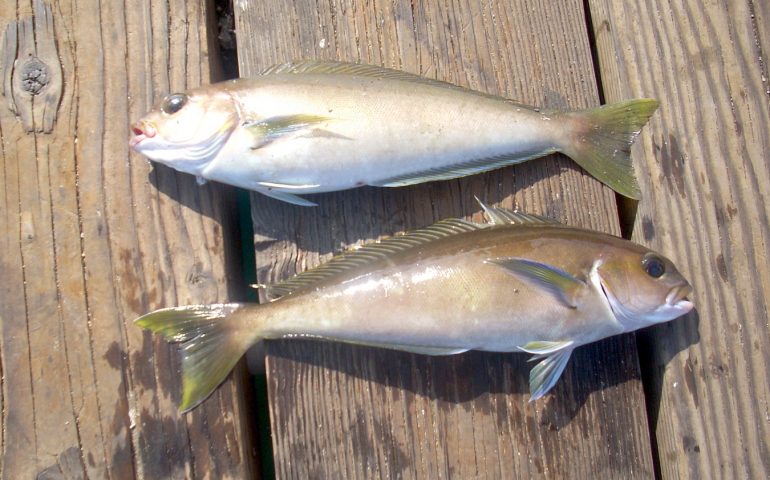
Tilefishes: Family Malacanthidae
Species: Caulolatilus princeps (Jenyns, 1840); from the Greek words caulo (stem) and latilus (probably a similar fish) and the Latin word princeps (leader).
Alternate Names: Poor man’s yellowtail, whities, blanquillo, blanka. In Mexico called pez blanco, blanquillo fino or pierna.
Identification: Elongate with a small mouth; distinguished by the very long single dorsal fin; long base of anal fin originates about middle of body; caudal peduncle rounded and slender. Brown to yellowish back, paler below; yellow or yellowish green edging on fins; blue stripe near edge of dorsal and anal fins. They also have very sharp serrated gill plates—so be careful in handling them.
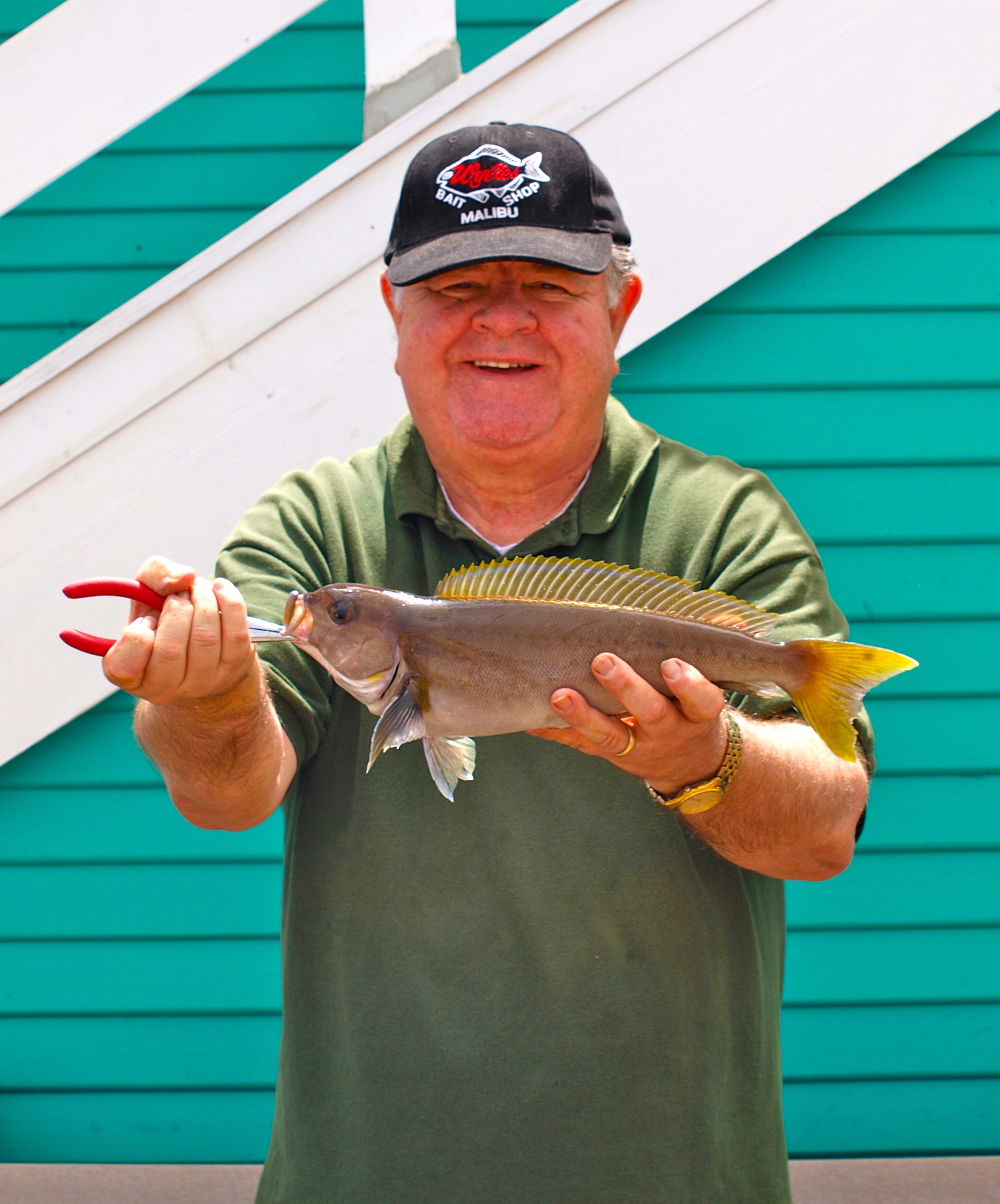
Size: To 40-inches, although most caught by anglers are less than 8 pounds in weight and most caught from piers are only 12-15 inches long. The California angling record fish weighed 13 lb 12 oz and was taken at the Cortez Bank, San Diego Co. in 1988. The diving record fish weighed 13 Lbs 12 oz and was taken at San Nicholas Island in 2010. The IGFA World Record fish weighed 17 Lbs 1 oz and was caught at the Hurricane Bank, California in 2011.
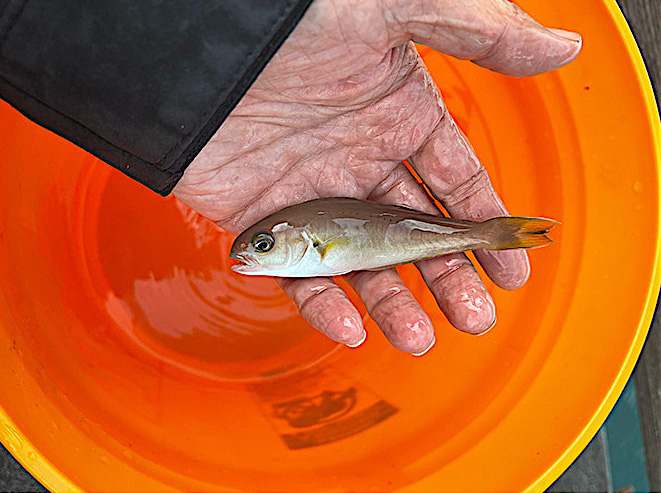
Baby ocean whitefish caught at the balboa Pier in 2022 by Evan Yeh
Range: Reported from Peru and Chile, the Galápagos Islands, and the Gulf of California north to Vancouver Island, British Columbia. Uncommon north of Point Conception and rare north of Monterey.
Habitat: Mostly found in offshore rocky reefs and banks although common around some kelp beds; shallow water in summer, deeper in winter. Found from shallow waters to at least 620 feet deep with the largest concentrations at 90-200 feet. Typically feeds on crabs, shrimp, octopuses, squid and small fish
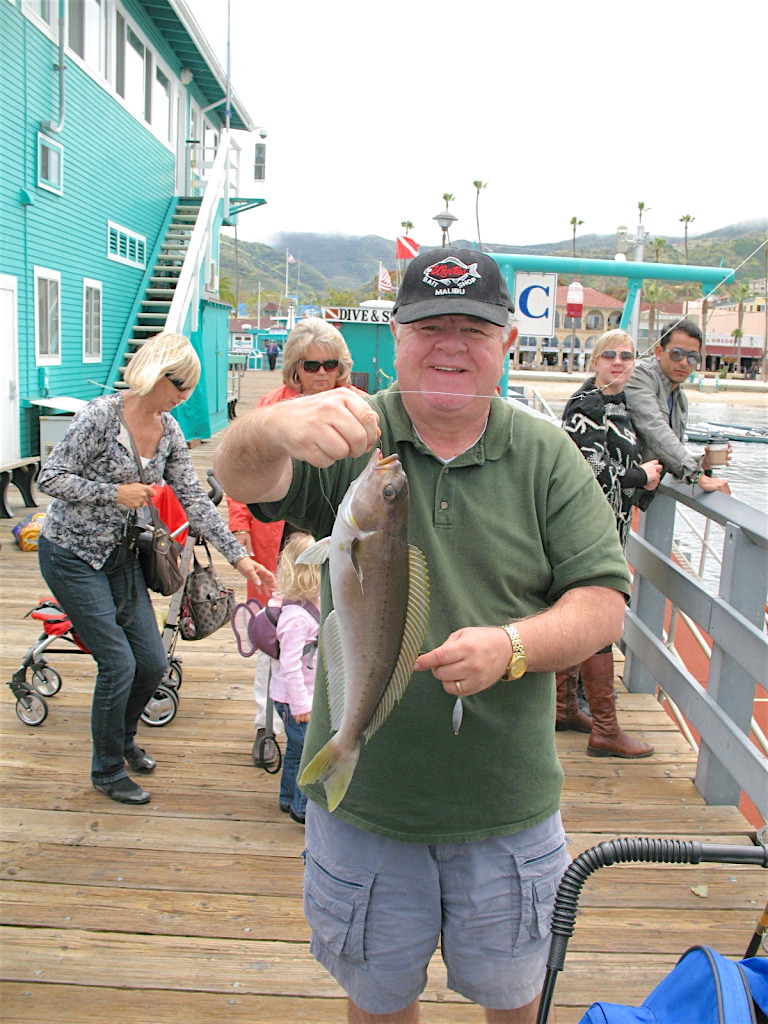
Another ocean whitefish from the Green Pleasure Pier in Avalon
Piers: Although occasionally seen at southern California piers near deep water or kelp, they are only really common at two piers, the Cabrillo Mole and Green Pleasure Pier, both in Avalon on Catalina Island. At the Green Pleasure Pier I have seen schools of ocean whitefish move into the waters around the pier and caught them on virtually every cast.
Shoreline: Rarely taken by shore anglers unless fishing at Catalina where they are common; Pebbly Beach near Avalon is a good spot late spring to summer.
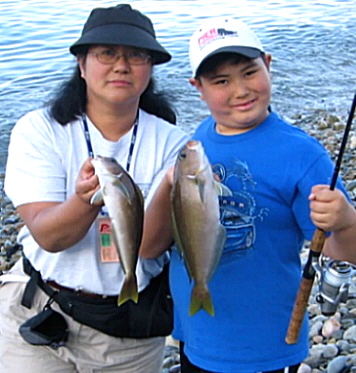
Ocean whitefish caught by Rita M and Kyle P at Pebbly Beach, Catalina Island
Boats: A common species for boaters fishing the southern California islands, especially Santa Catalina, Santa Barbara and San Clemente Islands; also reported to be abundant at the Cortez and Tanner Banks.
Bait and Tackle: Usually caught on the bottom though reported to typically feed four to six feet off the bottom. Top bait seems to be fresh squid cut into strips about 4 inches long and half an inch wide. It’s reported that a reverse dropper loop—with the hook on the bottom and the sinker hanging from a dropper loop a couple of feet up the line—can be deadly. Other good baits include ghost shrimp, market shrimp, mussels, worms and small live bait. Light to medium tackle and a size 4 or 2 hook is all that is needed for most of the pier-caught fish. Deeper water fish require stronger tackle.
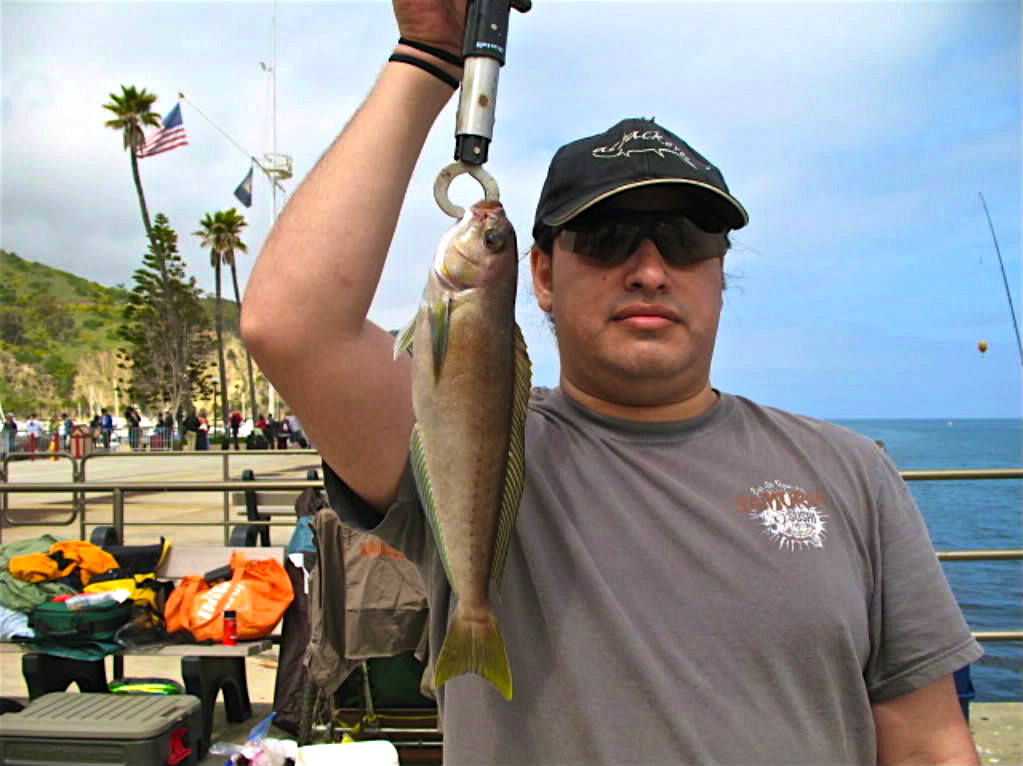
Ocean whitefish caught by Redkorn at the Cabrillo Mole in Avalon
Food Value: A good eating fish but somewhat bland in flavor with small flakes and a soft texture. The flesh is white in color and low in fat content. It can be prepared with basically any cooking method. However, some reports say that at certain times of the year, in certain areas, it seems to develop an unpleasant taste. As example, some people report a bitter taste from fish caught in shallow-water kelp beds (although apparently there’s no problem with fish caught in deeper waters). J. Charles Davis in his book California Salt Water Fishing (1949, A. S. Barnes and Company) said “an excellent food fish but should be skinned before cooking. The skin has a strong smell of iodine and if the fish is cooked without skinning, the flavor is imparted to the meat and makes it unpleasant. If skinned it is delicious.” I’ve only eaten skinned fillets and they were indeed delicious.
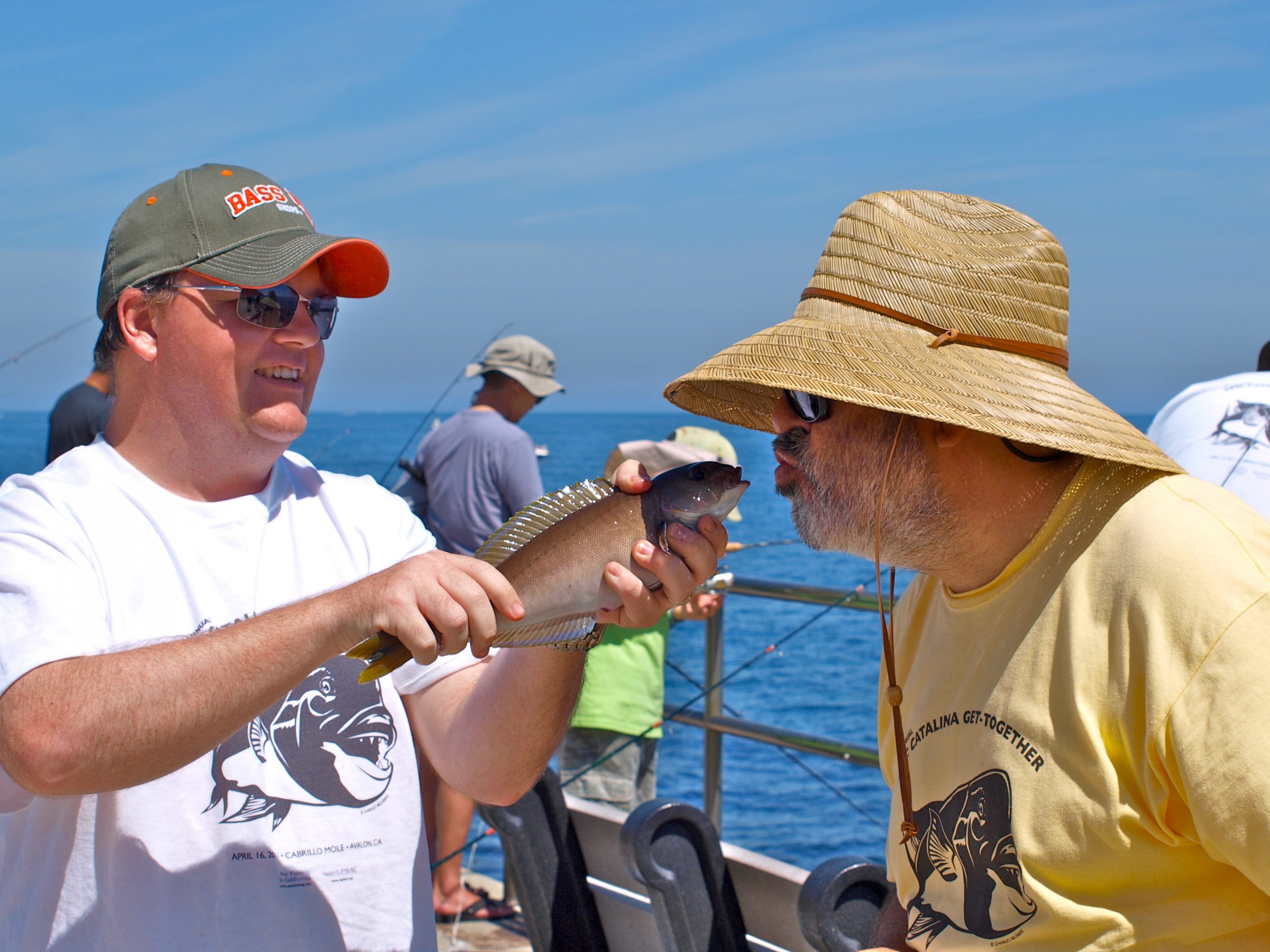
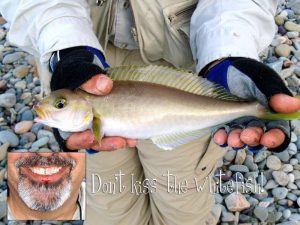
DO NOT KISS THE WHITEFISH, a lesson learned by Mahigeer (Hashem Nahid)
Comments: Due to the excellent fighting nature of these fish they are sometimes called the “poor man’s yellowtail.” Another more recent name, one apparently used on some partyboats, is “razor gill bottom dorado’ due to their very sharp serrated gill plates and the fight they put up. In California Salt Water Fishing by J. Charles Davis (1949), the author says “Be careful in handling this fish, when removing it from the hook, and when cleaning it. It has the sharpest gill covering (operacle) I’ve ever seen. It is actually razor sharp, serrated and will cut to the bone if you so much as touch it. While not poisonous, like the sculpin, it is quite capable of inflicting a very painful cut.” Given that their small mouths make them hard to lip latch many simply use a wet towel to grab and cradle their body.
One of my favorite quotes (and a quote within a quote) concerns ocean whitefish and comes from Milton Love’s great book Probably More Than You Want To Know About The Fishes Of The Pacific Coast. “Here’s a florid, but fun quote from C. F. Holder’s The Game Fishes of the World (1913, Hodder and Stoughton) about fishing for whitefish at San Clemente Island. ‘Possibly the finest game fish of this region among the small fishes is the Blanquillo or whitefish… When fishing with Dr. Gifford Pinchot in 1910 we found a rock one day rising to within ten feet of the surface then dropping to a great depth… The zone of thirty or forty feet was evidently devoted to the blanquillo… some weighing ten or twelve pounds. I took so many whitefish that day on the side of that beautiful mountain of the sea, up whose sapphire sides Queen Gulnore might have appeared at any moment, that I never felt quite the same regarding blanquillo.’ So, what’s the deal with the Queen Gulnore and why does she like whitefish so much?”
The Rest of the Story — Queen Gulnore (usually spelled Gulnare is a character found in Fairy Tales from the Arabian Nights and the story The King of Persia and the Princess of the Sea. She was a most beautiful and charming slave who was married to the King Saleh of Persia. Eventually he discovered that she is of royal blood from a kingdom under the sea and reunites her with her family. She chooses to stay with her husband and their child Prince Beder (who is able to breathe underwater and on land). As for whitefish—who knows?
I hate whitefish! They are extremely difficult to catch with hook-and-line due to their bait-stealing ability. They hardly ever take the whole hook, even when the hook is very small. Worst of all they do a lot of damage to you if handled incorrectly and produce very little meat.
An angler on a party boat I was on caught 30+ whitefish in two hours. He said he was putting a piece of cut squid the size of his pinky nail on a #3 J-hook. He then swung his rod violently at every little bump and nibble.
The book referred to in the comments – C. F. Holder’s The Game Fishes of the World (1913, Hodder and Stoughton) can be read or even downloaded for free at Archive.Org. It’s in the public domain.
As for Milton Love’s passage about blanquillo and the whimsical Queen Gulnore reference, it’s such a perfect example of how writers weave mythology, history, and fishing into something so vibrant. The imagery of “a beautiful mountain of the sea” and the connection to Arabian Nights adds an unexpected and poetic layer to the fishing tale. Queen Gulnore’s underwater kingdom ties neatly to the idea of marine wonder, but her connection to whitefish? Maybe it’s just the magic of storytelling—blurring the line between imagination and reality.
This dish looks incredible! Your roasted veggie tart was so vibrant and tasty. I found some crust tips on The Dead Seat that helped me get it just right. Any ideas for a vegan filling option?
They also have very sharp serrated gill plates—so be careful in handling them.
The fishing tips provided are incredibly useful for Southern California anglers, especially the bait recommendations and rig setup.
Thanks for this detailed guide on ocean whitefish! I found the tips about their sharp gill plates really helpful for safe handling while pier fishing in California. The identification details make it easier to spot them.
Thanks for this cool guide to ocean whitefish! I never knew they had such sharp gill plates—good tip to handle them carefully. The details on their colors and alternate names like ‘poor man’s yellowtail’ are really interesting.
Great breakdown on Ocean Whitefish from the pierfishing link informative for anglers and marine life fans. However, if you’re looking for annotated bibliography writing help, this site could be a source in a bibliography about fishing species or marine ecology, with a brief annotation that summarizes its focus on habitat, identification, and angler tips.
The description of the yellowtail is quite detailed, highlighting its unique features and coloring. It’s fascinating to learn about different names it goes by in various regions.
Nice work on this article. It’s always refreshing to read something that flows this well from start to finish.
The handling notes about sharp gill plates are genuinely useful for anyone fishing whitefish from a pier. runableai helps turn field notes, trip research, and rough content ideas into polished webpages, slides, visuals, videos, and documents in one AI workspace.
The bait and tackle section is especially clear, and the reminder about careful handling is useful for beginners. hakkoai is a practical resource for checking Hakko AI setup, safety notes, pricing, and compatibility before using the assistant.
This excerpt provides interesting insights into fish identification and nomenclature. The detailed description of the fish’s physical traits is informative for enthusiasts.
This excerpt offers interesting insights into fish identification and naming. The detailed description of the fish’s physical characteristics is especially useful for enthusiasts.
Detailed, beginner-friendly, and packed with useful fishing insights, this Ocean Whitefish guide keeps readers hooked from start to finish with easy-to-digest information.
This game is absolutely insane… I did the Pierrot route and my heart was POUNDING at the end. Can’t wait to try Harlequin’s route!
and Scratch Games free in your browser. Official levels and community-created versions. No download—instant play.
completed and I regret nothing! This horror game understands tension. Every death teaches you something new. The fair difficulty makes you want to try again and again. Perfection!
A yandere clown?? This is literally the combination I’ve been waiting my whole life for. The artwork is breathtaking and the story is incredible!
Free Online Pokepath TD Game
The Kid At The Back
Geometry Dash World
Cobb Can Move
Great info on ocean whitefish! I didn’t know they had such sharp gill plates. Good tip to be careful when handling them. The blue stripe on the fins sounds really cool too.
The fishing records mentioned highlight the impressive size of these catches, especially the IGFA World Record. It’s fascinating how different fishing methods yield varying sizes of fish.
The description of the fish species, including its identification and alternate names, is quite informative. The details about its physical characteristics make it easy to recognize.
The description of the fish species is indeed comprehensive, providing valuable insights into its identification and physical traits. Such detailed information is essential for enthusiasts and researchers alike.
I really enjoyed reading this detailed article about ocean whitefish. As someone who has fished off piers in Southern California, I’ve encountered these ‘whities’ several times. Your note about their sharp gill plates is spot-on — I learned that lesson the hard way! It’s fascinating that they can grow up to 40 inches, though most pier catches are smaller. I’ve always been curious about their preference for deeper water in winter. Thanks for sharing this comprehensive guide.
I found this article on ocean whitefish very informative, especially the details about their sharp serrated gill plates—I’ll be extra careful handling them next time. The mention of the baby whitefish caught at Balboa Pier reminds me of my own first catch there years ago. It’s interesting how the California record is from Cortez Bank, yet most pier catches are under 15 inches. I appreciate the thorough identification tips and range information. Thanks for sharing this valuable guide for shore-based fishing enthusiasts.
Great tips on targeting ocean whitefish from the pier. I’ve had the most luck using small pieces of shrimp near the pilings during an incoming tide, but I’ve never tried using mussel as bait—does it stay on the hook better than squid? Thanks for sharing your experience!
Your blog posts are like a breath of fresh air, always inspiring and beautifully written!
Your blog posts are like a breath of fresh air, always inspiring and beautifully written!
Great read! I’ve had some luck with ocean whitefish off the Santa Monica pier using squid strips, but I never tried fishing near the pilings like you mentioned—definitely going to give that a shot next time. Do you find they bite better early morning or late afternoon?
Our dedicated restoration experts at Restore Old Photos carefully enhance every detail, ensuring your historical photographs are preserved beautifully.
What a fascinating read! It’s always great to learn more about the diverse fish species out there. The detail on the Ocean Whitefish, especially its identification and various names, is really insightful. I found the mention of the sharp serrated gill plates a crucial safety tip for anglers. It’s cool to see the range and record sizes too – quite the catch for those lucky anglers! You’ve presented some truly valuable information here, much like how a good simulator might offer detailed insights. This article is a real catch, and I appreciate the deep dive into this particular species, just as I appreciate a well-researched guide. This article is truly a fantastic read and provides some wonderful insights into the ocean whitefish.
Ai Photo Enhancer is a fast and easy AI-powered photo enhancement tool.
I’ve been experimenting with AI-assisted design lately and found Make Poster With AI. It’s been great for turning wild ideas (like pixel art or cinematic themes) into quick poster drafts. It really aligns with some of the aesthetics you mentioned in this post. Thanks for the inspiration!
The description of ocean whitefish at the Green Pleasure Pier highlights an exciting fishing experience in Avalon. It’s fascinating to learn about their abundance in specific locations like Cabrillo Mole and Pebbly Beach.
The bait advice is especially practical: the article notes that fresh squid cut into strips about 4 inches long and half an inch wide can be effective. The detail about using a reverse dropper loop is useful too.
That warning about razor-sharp serrated gill plates belongs at the top of any pier-trip checklist; after one rushed unhooking left a teammate with a deep cut, I made pliers mandatory for our group. As a manager, I have found a short daily Pips puzzle check-in helps keep small, repeatable team routines visible, provided safety remains non-negotiable.
The 1RM Calculator uses proven formulas trusted in strength training.
This passage provides a detailed description of the fish species known as yellowtail, highlighting its unique features such as the elongated body and distinctive fins. The warning about sharp gill plates is particularly important for handling.
The description of the yellowtail fish is both informative and engaging, particularly with its emphasis on handling precautions due to sharp gill plates. Such insights enhance our understanding of marine life.
The description of yellowtail fish is indeed captivating, especially the handling precautions regarding sharp gill plates. It’s crucial to raise awareness about marine life safety.
Playing 2v2.io with a friend is way more fun than playing solo. 4a974921.
Fresh squid strips make sense here, though deeper fish may need stronger tackle.
I’ve had some luck with ocean whitefish off the Santa Monica pier using squid strips, but I never tried fishing near the pilings like you mentioned—definitely going to give that a shot next time.
Great info on ocean whitefish. Learn more about AI video production costs. learn more
The warning about razor-sharp gill plates is exactly what a first-time angler could miss. I will use pliers and handle the gills carefully next time.
This is a cool post about ocean whitefish. I didn’t know they had such sharp gill plates, so that’s a good warning to remember. The long dorsal fin and blue stripes on the fins sound really neat too. Thanks for sharing these helpful fishing tips!
The description provides a fascinating insight into the fish’s characteristics and naming origins. Its unique features, like the elongated body and distinctive dorsal fin, make it stand out in the aquatic world.
The description beautifully highlights the fish’s unique traits, particularly its elongated body and dorsal fin, which truly set it apart in the aquatic realm.
The note about very sharp serrated gill plates is easy to overlook. I would handle an unfamiliar catch from the sides, not the gills.
The project pairs WebAssembly with browser storage to make the game playable on the web. 5e965c25.
That warning about the serrated gill plates is especially useful; a fish that fights well can still turn a routine landing into a cut. I would adopt the light-tackle approach only with a landing grip or pliers ready.
Really comprehensive article on ocean whitefish! I fished Green Pleasure Pier in Avalon last summer and managed to hook a couple of these “poor man’s yellowtail”. That warning about their razor‑sharp gill plates cannot be overstated — I learned to always use pliers and a wet towel when handling them. The reverse dropper loop rig and fresh squid tips are spot‑on for pier anglers. Great to also read about their habitat and size records, thanks for putting this together.
This guide has been incredibly helpful for a relatively new Southern California pier angler. I had seen small ocean whitefish before but struggled to positively ID them. I didn’t realize how rare they are on mainland piers and how concentrated they are around Catalina Island. I also appreciated the food value notes about skinning them before cooking. I’m planning a trip to Avalon soon and will definitely target these fish using your bait recommendations.
Co-op play lets up to four friends survive the hordes together. b276f446.
Escaping with a class spell can save a run from a difficult moment. 821dda8a.
With pier fish often 12-15 inches, is fresh squid still the best bait?
Appreciate the clear 90-200-foot habitat range and the note that summer fish move shallower. That seasonal shift makes depth more useful than a fixed spot, though local structure still matters.