Phylum: Chordata — Class: Actinopterygii (ray-finned fish)— Order: Perciformes (perch like)— Family: Priacanthidae (bigeyes or catalufas)— Genus: Heteropriacanthus (Fitch and Crooke, 1984)
Species: Heteropriacanthus carolinus (Cuvier, 1829); from the Greek heteros (different), prion (saw), and akantha (thorn) and the Latin carolinus (in reference to geographic area).
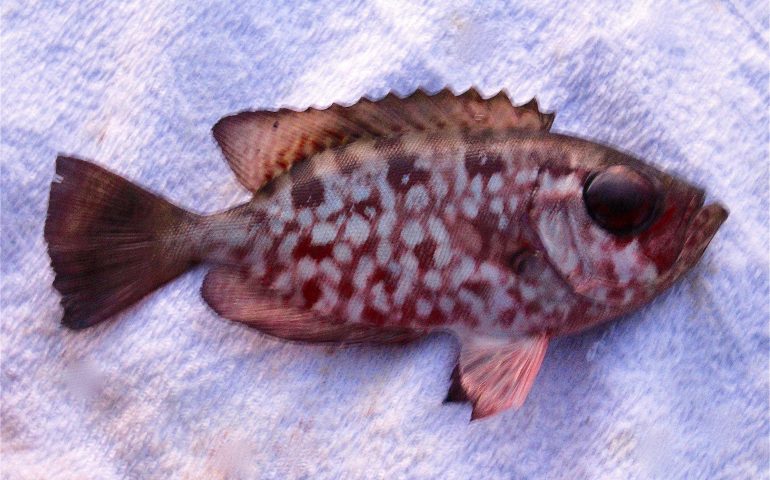
Identification: Silvery pink, mottled red or solid red in color; median fins with faint dark dots. Pelvic fins dusky or pale and without distinct spots. Section of preopercle behind canal striated and without scales. Dorsal spines (total): 10; Dorsal soft rays (total): 12-13; Anal spines: 3; Anal soft rays: 13 – 14.
Size: Most that are seen are around 8 inches in length; maximum length about 20 inches.
Range: Circumglobal in tropical and tropically influenced seas. Common in island habitats throughout the central Pacific. In the Eastern Pacific found along island habitats from off Baja California to the Galapagoes; probably uncommon along coast of Mexico, Central and South America, questionably to Chile.
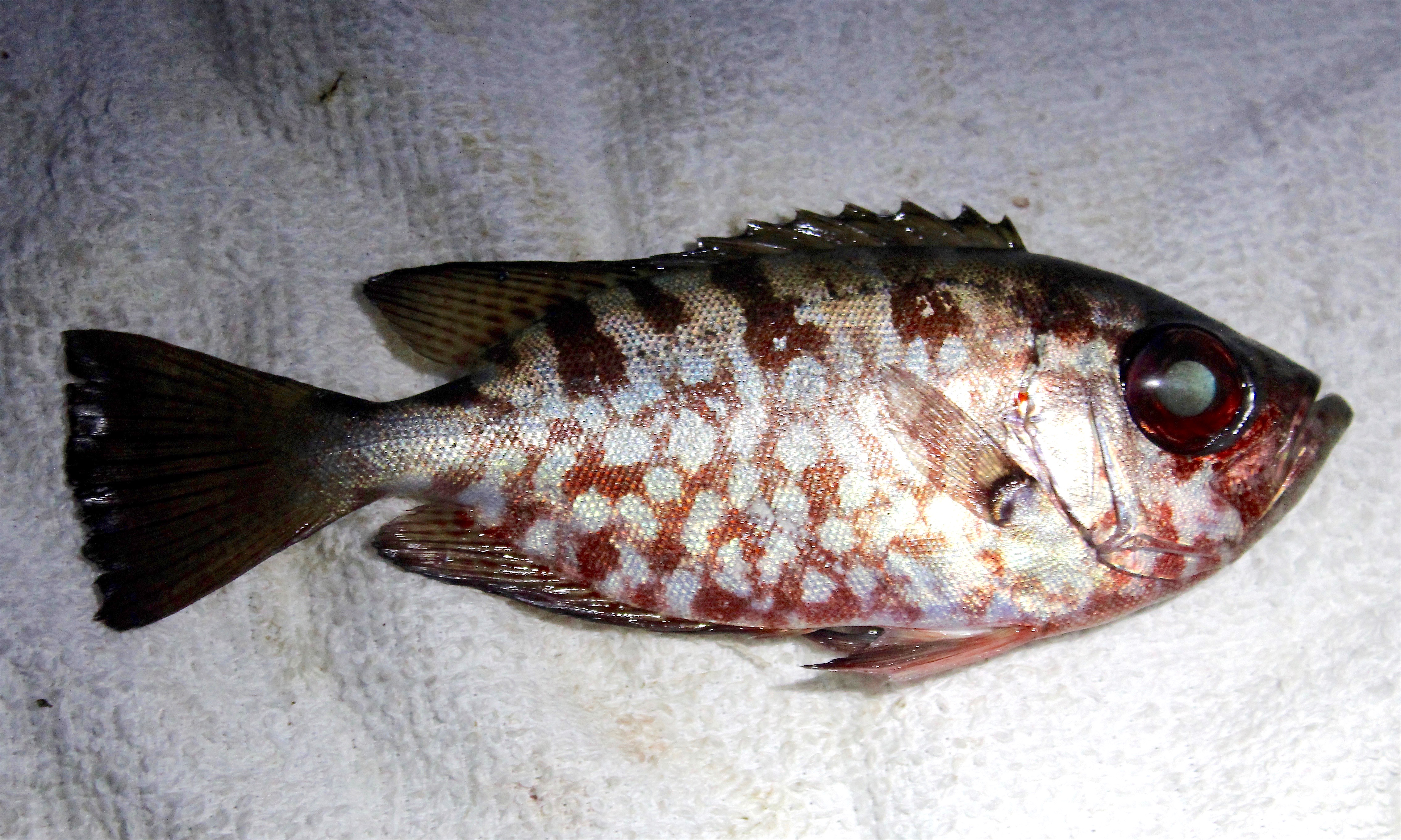
Stressed fish prior to release
Habitat: Common in lagoon and seaward reefs, primarily around islands. Typically found in water 10 to 100 feet in depth although recorded to a depth of about 900 feet. Under or near ledges by day. Nocturnal, feeding mainly on octopi, pelagic shrimp, stomatopods, crabs, small fish, and polychaetes . Solitary, during the day usually occurring singly or in small groups; at dusk it may gather in large numbers. Known to produce sound.
Piers: In California, only recorded at the Cabrillo Mole, Avalon, Catalina Island.
Shoreline: Not recorded in California.
Boats: Not recorded in California.
Bait and Tackle: The one caught was at night on a piece of shrimp.
Food Value: Marketed in fresh fish markets although some reports of ciguatera poisoning
Comments: In December 2017, I made a trip to Avalon on Catalina Island. The last afternoon was spent fishing on the Cabrillo Mole with the usual species being caught. At 5:30, with darkness descending, I stopped fishing and headed over to get a cup of hot chocolate. Upon my return I packed up the gear and sat down to relax and wait for the last ferry back to the mainland.
My rest was interrupted when I saw a nearby angler pull in a fish. I walked over to see what he had caught which, I expected, would be a type of rockfish or a salema, both of which hit well at the Mole after it is dark.
However, the fish turned out to be a species that was new to me (and a quick check of my reference book did not reveal a picture). My first thought had been of a juvenile giant sea bass (it was only 5-6 inches long) but the fin structure was wrong. My next thought was of a popeye catalufa, the fin structure was about right but the color was wrong. My friend Hashem and I talked the angler into letting us take a couple of quick photos before returning the fish to the water. Since I am always seeking out new species, that fish, even though I didn’t catch it, put the final cap on the trip.
Upon returning home I sent a copy of the pictures to Milton Love at UC Santa Barbara for identification but he said he’s never seen it before. He said he would send the pictures out to a network of experts who should be able to identify it. It took a while but eventually it was decided that the fish was probably a Pacific glasseye, Heteropriacanthus carolinus, a fish more common to Indo-Pacific waters like Hawaii and Australia.
Unfortunately, we had returned the fish to the water which Mr. Love let me know is generally good but in this case might have provided a definitive answer to the species (me bad!). Nevertheless, it may be the first recorded sighting of the fish in California.
Main Reference: FishBase — Starnes, W.C., 2018.FishBase.World Wide Web electronic publication. www.fishbase.org, (06/2018)
https://www.fishbase.de/summary/Heteropriacanthus-cruentatus.html#
“The glasseye fish Heteropriacanthus, previously known as a monotypic genus, is now divided into three species based on morphological and genetic features. After examination on the type specimens and literature, herein we resurrect two junior binomens, H. carolinus (Cuvier, 1829) from the Indo-Pacific Ocean and H. fulgens (Lowe, 1838) from the northeastern Atlantic Ocean. Heteropriacanthus cruentatus (Lacepède, 1801) is now considered to be restricted to the Atlantic and southwestern Indian oceans. In light of these observations we discuss the evolutionary history of the genus.”
https://www.ncbi.nlm.nih.gov/pubmed/28610238
“Glasseyes or glass bigeyes (Heteropriacanthus) are a genus of the bigeye family found in all tropical seas around the world. It occasionally makes its way into the aquarium trade. It grows to a size of 50.7 cm (20.0 in) in total length… All glasseyes used to classified in a single species, Heteropriacanthus cruentatus…but recent morphological and genetic analysis indicates that glasseyes should be divided into three species: Heteropriacanthus cruentatus (Atlantic Ocean and southwest Indian Ocean), H. fulgens (northeastern Atlantic), and H. carolinus (Indo-Pacific).“
http://www.wikiwand.com/en/Heteropriacanthus
This is awesome, we have something similar here in the FL Keys I think it is a Glasseye Snapper.
Fascinating to learn about the Pacific Glasseye, a gem among the diverse fish species encountered at California’s piers.
The Pacific Glasseye’s rare appearance in Californian waters adds intrigue to the region’s marine biodiversity.
i like this post
Pacific Glasseye is a unique deep-sea fish known for its large, reflective eyes and striking appearance. Found in the Pacific Ocean, it adds to the rich biodiversity of marine life and fascinates researchers and ocean enthusiasts alike.
Common in lagoon and seaward reefs, primarily around islands
The “saw-thorn” description really paints a picture. It reminds me of how delicate you have to be – like trying to maneuver a really fragile object. You know, sometimes after reading about something so precise and detailed like this, I just need to zone out. I’ll play a round or two of Eggy Car just to unwind. It’s funny how stressed I get trying not to drop that egg, though!
Okay, wow, twenty inches! That’s a pretty big “thornfish,” eh? I didn’t realize they got that big. The description of the coloring is interesting, too – “silvery pink, mottled red or solid red.” It’s cool how much variation there can be within a single species. It kind of reminds me of different enemy types in horror games, like, same base monster, different skin, slightly different stats. Wonder if the redder ones are meaner? Haha, just kidding… I think. Anyway, great info!
This was a great read, especially the story behind discovering what might be the first Pacific glasseye recorded in the area.
I like how the article mixes detailed fish info with a real fishing experience—it makes the Pacific glasseye even more interesting.
Nhà cái Bj88 đá gà luôn cập nhật lịch thi đấu mỗi ngày, giúp người chơi chủ động thời gian để theo dõi sát sao.
hubet không chỉ là nhà cái, mà còn là một kho tàng kiến thức cho những ai đam mê bộ môn cá cược này.
That Pacific glasseye story is WILD! Imagine being the first to spot one in California – talk about a fishing trip to remember! It’s so cool you sent pics to Milton Love, even if releasing it meant missing a definitive ID. Is five nights at freddy’s still worth playing in 2026? Just wondering, have you caught anything else unusual since then?
What’s the most interesting fish you’ve seen while diving? I’d say the Bigeye! Their huge eyes and red color make them striking underwater. I remember seeing a school of them huddled under a ledge in Cozumel, a truly unique sight. Wonder how many end up in the Repo.
I find it interesting how the name of the Pacific Glasseye reflects both Greek and Latin roots. It’s neat that different languages can help describe the species. I’ve come across them during my dives and they have such unique features. Thanks for sharing this detailed classification.
These unique fish species could make great inspiration for customized gifts and creative merchandise. Their distinctive appearance would look amazing on printed mugs, t-shirts, caps, or collectible items for fishing enthusiasts. Personalized gifts featuring marine life themes are a great way to celebrate a passion for fishing while creating something memorable and unique.
Interesting read about the Pacific Glasseye! I had no idea these bigeye fish could be caught from California piers. The description of their distinctive large eyes and nocturnal feeding habits is really well written. I run a creative image platform at nanobananapro.pics where users generate and share AI artwork – it would be amazing to see someone create illustrations of these unique fish species. The habitat information about them living near rocky reefs at depth is particularly useful for anyone looking to target this species. Thanks for sharing this comprehensive species profile!
The Pacific Glasseye is an interesting deep-water reef fish known for its large eyes, nocturnal behavior, and striking red or pink coloration, typically found around rocky ledges and island habitats in tropical waters.
I benefited greatly from the information in this post. Thank you.
This is a fascinating and well-researched article about the Pacific Glasseye. The detailed species information and the real-life discovery at Catalina Island show how careful observation can contribute to marine science and fish identification.
Bij Research Chemicals Kopen hanteren we een ethische werkwijze en zullen we nooit verboden stoffen kopen of verkopen. Benzodiazepinen Kopen
The real cost becomes clearer only after comparing the cash received at the beginning with the total amount owed later, because 카드깡 can include deducted fees, delayed billing, settlement conditions, and repayment pressure that may make the final burden much heavier than the first payout suggests.
been looking into this lately and this breakdown is pretty solid
Nice post. I like it
This is a really fresh and engaging concept — thank you for sharing such an interesting article!
What a remarkable Catalina Island observation! The Pacific glasseye’s nocturnal habits and Indo-Pacific distribution make this possible California record especially intriguing. It’s a great reminder that careful photos and shared expertise can reveal unexpected species. Even without a specimen, the documentation adds value—sometimes nature knows how to kick the buddy of certainty and keep anglers curious.
The Pacific Glasseye impresses with its large, round eyes, brilliant reddish-pink body, and nocturnal feeding habits. It is extremely rare in California!
Just wondering, have you caught anything else unusual since then?
Mình đánh giá netmirror khá tốt vì hoạt động mượt trên iPhone của mình. TONY09-03
A true oceanic enigma, its identity eluded initial classification. I once wrestled with identifying a bizarre insect in my garden, its features defying all my insect guides. It felt like playing a real-life Moto x3m level, trying to navigate through endless possibilities.
Pacific Glasseye is informative and we are here to find the best options and it is a great option for us to deal with it and it will bring the right ideas to us. When I tried it I got what I was looking for.
I caught 3 or 4 of these off the coast of Newport Beach last night!! Never caught this species and was genuinely surprised.
I recall a Crossy Road-esque moment trying to categorize an unknown insect based on a blurry photo and partial description. It was a frustrating, feature-matching puzzle.