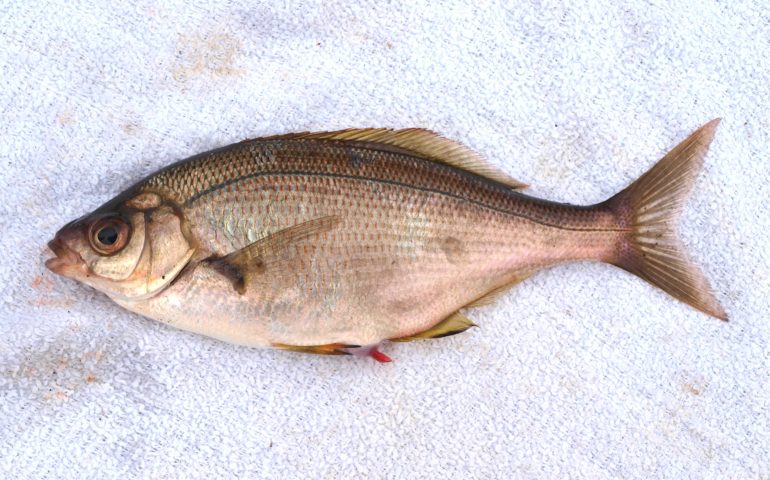
Surfperches: Family Embiotocidae
Species: Phanerodon atripes (Jordan & Gilbert, 1880); from the Greek root words phaneros (meaning evident) and odons (tooth) meaning (for some reason) that this fish does not have large teeth and the Latin words atri (entrance or black) and pes (base of or foot) for the black-tipped pelvic fins. Family Embiotocidae, subfamily Embiotocinae.
Alternate Names: Blackfoot seaperch and sharpnose surfperch. In Mexico called mojarra picuda.
Identification: These surfperch are very similar in shape to the white seaperch but coloring is different and the pelvic fins are black tipped. Their coloring is silvery with reddish-brown marks on the back, and black or dusky-tipped pelvic fins.
Size: To 11.5 inches but most caught from piers are between 8-10 inches.
Range: Islas San Benito, central Baja California, to Yaquina Bay, Oregon. Common from Punta Baja, northern Baja California, to central California.
Habitat: A structure-oriented fish that is found from shallow water down to deep water—750 feet deep. Often found in kelp beds, eelgrass beds, over rocky reefs, and around oil platforms.
Piers: During the summer months the females move from deep waters into shallower waters to give birth. At such times they are sometimes found in schools mixed with blackperch, pileperch, and white seaperch. During these summer months it is an infrequent catch at several Monterey Bay piers. Best bets are the Monterey Wharf #2, Monterey Coast Guard Pier, and the Santa Cruz Wharf.
Shoreline: An occasional catch by shore anglers in central California.
Boats: An inshore species rarely taken from boats.
Bait and Tackle: By far, the best bait is live pile worms or small crabs; next would be fresh mussels or small pieces of shrimp. The most common setup used by locals in Monterey is a small size 8 hook fished directly on the end of the line with a small split-shot sinker attached a short way up from the hook. Above this is attached a small bobber which indicates when the fish bites; anglers here seem to give a quick jerk to try to hook the light-biting fish. The fish are generally found in the surface canopy or mid-depth area, which is one reason for using the bobber. The ones I have caught were all taken on a high/low leader.
Food Value: Most are fairly small yielding little meat. The flesh is mild in flavor with small flakes and soft texture. They taste best during the non-spawning season, are low in fat content, and can be cooked using most methods.
Comments: This seems to be one of the harder perch to hook. I spent several exasperating hours fishing for these perch at the Monterey Wharf #2 and watching locals (a few with the know-how) catch them before I caught my first sharpnose seaperch. However, since then I’ve caught several of the fish at the pier using my normal high/low leader and adjusting the depth of the line to where I was getting bites.
For whatever reason, there has seemed to be considerable fluctuations in the population of these fish over the years—or at least in the reported population. Jordan and Gilbert (1882) said “Monterey Bay, locally abundant,” while Eigenmann (1893) said “the commonest species in Monterey Bay.” However few sharpnose were reported in Fish and Game surveys over the years until the 1960s when they again began to show up in decent numbers.
It’s reported that sharpnose seaperch act as “cleaner fish” during the fall when Mola mola, the ocean sunfish, come in to the shallow waters at Point Lobos just south of Monterey.
Fascinating read! I didn’t realize sharpnose seaperch acted as cleaner fish for mola mola. Nature always has such unexpected relationships.
Your approach is similar to what I’ve been doing, but with some great additions I hadn’t thought of.
Great UX guide! The usability testing tips were especially valuable.
Sharpnose Seaperch (Phanerodon atripes) is a marine fish species belonging to the surfperch family (Embiotocidae), commonly found along the Pacific coast of North America.
Great info on the sharpnose seaperch. Clear, helpful tips on identification and pier fishing — really useful read.
Great breakdown of the sharpnose seaperch. I appreciate the clear description of their habits and where anglers are most likely to find them. It’s helpful to understand how structure, depth, and bait choice all play a role, especially for those who might overlook this species while targeting others. Informative and practical for anyone fishing from a pier.
Slot nổ hũ tại slot365 link nổi tiếng “mát tay” nhờ cơ chế jackpot tích lũy liên tục từ cộng đồng người chơi. Nhiều thành viên đã đổi đời chỉ sau một lần quay trúng Jackpot trị giá hàng trăm triệu đồng. TONY03-11O
These girls will consistently motivate you to explore new things alongside them. Enamored with our companions, you will experience the finest sensual fun with our escorts.
The Sharpnose Seaperch is a relatively small, coastal fish found mainly along the Pacific coast of North America, especially from California up to British Columbia. It’s part of the surfperch family, which are known for their unique reproductive habits and nearshore lifestyles.
Sự kết hợp giữa giải trí và cập nhật kiến thức tại hubet thực sự mang lại giá trị lớn cho người tham gia.
Đăng ký tài khoản tại Bj88 đá gà rất đơn giản, chỉ vài phút là có thể tham gia đặt cược trận đấu yêu thích.
Just what I was looking for.
This article is a gem.
Every sentence here adds value.
Could someone with little experience do it, and add updates without messing it up?
Good information on here, very informative.
I’ve been reading your entries all the way through my morning break, and I must admit the entire article has been very enlightening and very well written.
Congratulations on having one of the most sophisticated blogs Ive come throughout using some time!
Its just incredible what you can remove from anything as a result of how visually beautiful it’s.
They are keen to explore every secret fantasy you hide. Our Andaz Hotel Escorts offers bold, 18+ partners who crave physical pleasure. Every intimate moment leads to mind-breaking orgasm. They turn your hotel into an adventure zone. Trustworthy, wild, and completely devoted, they will make you moan. We create nights of pure bliss. Let their keen desire match yours. One booking and you’ll understand real satisfaction.
This is an interesting fish with a unique name. I didn’t realize the meaning behind its name and how it relates to its features. It’s fascinating how language and biology come together in naming species. I wonder how common the Sharpnose Seaperch is in coastal areas.
Great detailed profile on the sharpnose seaperch! I had no idea this species was also called the blackfoot seaperch. The comparison with other surfperch species really helps with identification – the pointed snout and dark markings near the pectoral fin base are key features to look for. The best bait recommendations are also really practical. This whole pier fishing fish guide is incredibly comprehensive – bookmarked for my next trip to the coast.
Great writeup on the sharpnose seaperch! The identification tips about the black striping on the dorsal fin are really helpful for anglers trying to tell them apart from other surfperch species. I run a creative image editing platform and we actually get requests for fish identification photos from time to time — this kind of detailed reference material is invaluable. Thanks for sharing your knowledge about California pier fishing!
The sharpnose seaperch is one of those species that a lot of people catch but do not think much about. Your breakdown of the differences between sharpnose and other surfperches is really valuable. I caught what I think was one of these off the Venice Pier last month and was not sure about the ID until reading this. The eating quality section is also helpful since I have been wondering if they are worth keeping.
I benefited greatly from the information in this post. Thank you.
I liked the practical detail about live pile worms or small crabs and adjusting depth for the light bites. Notes like that are exactly the kind of thing I try to keep searchable after watching or recording pier-fishing clips.
When quality matters most, choose companions who understand your needs. An Escort in Bijwasan offers refined company that goes beyond ordinary encounters. She is sophisticated, well-mannered, and deeply attentive to your emotional requirements. Her goal is simple: to provide genuine care and unforgettable experiences.
Bij Research Chemicals Kopen hanteren we een ethische werkwijze en zullen we nooit verboden stoffen kopen of verkopen. Benzodiazepinen Kopen
How do you cook this kind of fish?
The note about adjusting the depth of the line to where you were getting bites stood out to me; it makes this feel less like a fixed recipe and more like reading the situation. That same gradual approach is why I like using Pips Hint for NYT Pips, where a small clue can be enough before checking the full solution.
The game continues to exceed expectations with each update.
A more practical way to evaluate the situation is to compare the immediate cash received with the total amount that may be owed later, since fees, billing timing, settlement rules, and repayment pressure can make 카드깡 far less simple than it appears at first.
The note that sharpnose seaperch can act as cleaner fish near Point Lobos was especially interesting. I keep species pages like this as Markdown field notes, and a local live preview is handy for checking tables, links, and export-ready summaries before sharing them.
As someone who writes daily Pips puzzle hints, I appreciate guides that narrow things down step by step. The detail about black or dusky-tipped pelvic fins made the identification section especially clear.
The small bobber detail for detecting light bites was especially helpful. I enjoy that same patient, small-scale creativity in Townscaper, where building island towns block by block is wonderfully relaxing.
That note about live pile worms or small crabs being the best bait is a useful detail, especially alongside the small bobber setup for detecting light bites. For a casual trip, I like using Number Wheel to make a fair, quick choice between bait or depth options before the first cast.
The practical detail about using a small size 8 hook with a bobber makes this guide especially useful for understanding how lightly biting surfperch behave. I appreciate that same patient, incremental approach in Oskarstalberg City Generator, where each block helps shape a town.
That detail about the fish being found in the surface canopy or mid-depth area makes the bobber recommendation especially clear. I appreciate the step-by-step explanation, much like the progressive hints I use on Pips Hint when working through a tricky NYT Pips puzzle.
The practical details here are excellent, especially the setup with a small size 8 hook, a small split-shot sinker, and a small bobber. The advice to adjust the depth of the line to where you are getting bites also highlights how much small decisions matter, which is part of what makes Hearts Game enjoyable when passing cards and trying to avoid penalty points.
The note about using a small bobber to indicate when the fish bites is especially helpful, since it explains why this setup suits light-biting sharpnose seaperch. After a day at the pier, Hearts Game is a convenient no-download way to unwind with a few rounds against computer opponents.
Your small size 8 hook, bobber, and depth adjustment advice creates a useful repeatable test: change one variable at a time and confirm that bites still come from the surface canopy or mid-depth. I am applying that loop to a current project with an adjustable AI partner in four-player Spades, comparing steady bag totals with aggressive bidding. A bobber gives faster feedback than a high/low leader but sacrifices control; when I am fishing for a Nil, would you favor the visible signal or tune the depth manually?
Could the size 8 hook, small split shot, and bobber make this light-biting setup easier to execute consistently? My tentative answer is yes: I would mark the starting depth and change only one variable when bites disappear, turning the Monterey setup into a repeatable test across sessions. That kind of disciplined tracking also helps when an exact target must be predicted and managed over successive rounds.
While reviewing footage from a pier trip, I noticed how often a missed bite came down to inconsistent depth. Your note that sharpnose seaperch stay in the surface canopy or mid-depth, and that anglers adjust the line to where bites appear, suggests a simple team process: log depth and conditions after each drift so the next shift starts with evidence. I sometimes use Video To Text to turn recorded fishing discussions into searchable notes, then compare them with the catch log. That makes the depth adjustment easier to repeat rather than relying on memory.
The advice to fish the surface canopy with a bobber makes sense for light bites. I would watch for a steady float dip before adjusting depth.
The 8-10 inch pier catch range surprised me; a smaller fish could still count.
The bobber helps only when depth matches the bite, so I would log each adjustment.
Oddly, the 8-10 inch norm matters more than the 11.5-inch maximum. Our pier team starts with a size 8 hook and bobber instead of chasing heavier tackle.
The bobber suits light bites; after the pier, a quiet Hearts round is a fitting reset.
I love how original this concept is — thanks so much for sharing the article!
The bobber detail is excellent; light bites should register near the surface canopy.
A small bobber helps reveal light bites when sharpnose perch hold mid-depth.
Does the bobber really help detect bites when sharpnose stay in the surface canopy?