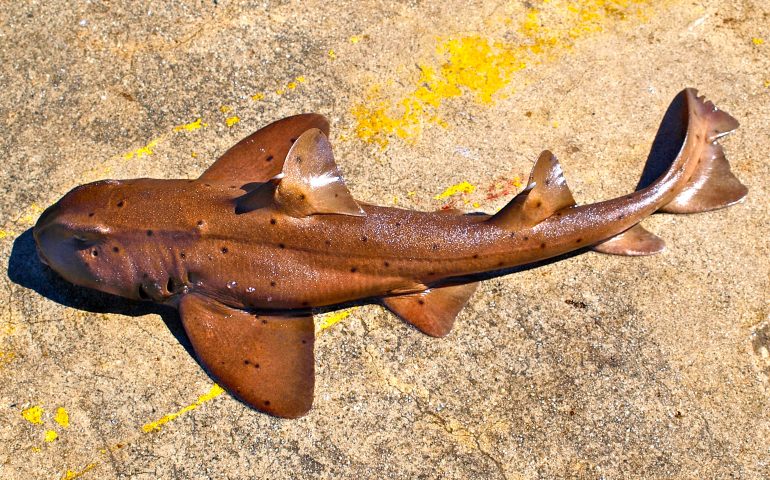
Bullhead Sharks: Family Heterodontidae
Species: Heterodontus francisci (Girard, 1855); from the Greek hetero (different) and odont (tooth) and the Latin francisci (referring to San Francisco). (They have a small pointed tooth at the front of their jaw and a blunt tooth at the rear.)
Alternate Names: Bullhead Shark, Port Jackson shark, horned shark, hornback shark. Called tiburón cabeza de toro, tiburón cornudo or tiburón puerco in Mexico.
Identification: Horn sharks are spotted sharks with a somewhat pig-like snout. They have a strong spine at the front of each dorsal fin, which accounts for their name. Their coloring is tan to dark brown or grayish with black spots above, pale yellowish below. Young fish sometimes have white spots.
Size: Reported to 48 inches but the largest verified was just over 38 inches long and 22 pounds. Most hornies caught from piers are less than 30 inches in length. The IGFA World Record fish weighed 6 Lb. 11 oz. and was caught at Catalina Island in 2015.
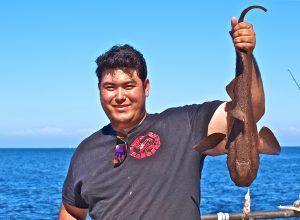
Horn shark caught at the Cabrillo Mole in Avalon
Found in the tropics, Peru to Columbia, the Pacific coast of Mexico, the Gulf of California (Sea of Cortez), and California. Common in southern California. Less common but found north to San Francisco Bay and Bolinas Bay, northern California.
Habitat: Found from intertidal areas down to about 650 feet. Young horn sharks seem to prefer relatively shallow, sandy flats while the adults prefer rocky reefs and kelp beds. They are nocturnal, bottom-feeding foragers who prefer to spend their daylight hours resting on the bottom or in caves and crevices. At night they head out in their search for food—primarily squids, urchins, crustaceans, anemones and mollusks—but rarely are they found more than six feet from the bottom. Juveniles like softer-bodied prey like worms and sea anemones. In some areas the horn sharks move out to deeper waters during the winter, colder-water months.
Piers: Most are caught at southern California piers but a few are caught at piers in CenCal, i.e., Cayucos. Generally found near piers that are close to reefs or kelp. Best bets: Ocean Beach Pier (now closed), San Clemente Pier, Hermosa Beach Pier, Green Pleasure Pier (Avalon), Cabrillo Mole (Avalon), Santa Monica Pier, Paradise Cove Pier, Goleta Pier, Gaviota Pier (now closed). They are generally harmless but anglers should be careful of the sharp dorsal spines and be aware that agitated fish may try to bite careless handlers (and they can give a nasty bite).
Shoreline: Occasionally caught by anglers fishing rocky areas near kelp.
Boats: Sometimes taken by boaters and kayakers fishing the southern California kelp beds.
Bait and Tackle: Crabs, shrimp, squid and small fish are prime baits but hornies appear to take almost any natural bait. Most horn sharks taken by pier anglers are fairly small fish so light-to-medium tackle equipped with size 2 to 2/0 hooks will suffice.
Food Value: Edible, firm textured meat but considered somewhat inferior to most other sharks. Some anglers claim a mild taste while some report the meat being darker and stronger flavored than most sharks. Must be properly bled and cleaned (as with all sharks) and some claim the meat can have a muddy or metallic taste. When used, they are generally filleted and fried in some manner. The skin is very tough so have a sharp knife and a whetstone to keep it sharp. Due to the effort needed to clean them, and the small amount of meat, most anglers simply release them.
Comments: An interesting little shark. The females typically lay two egg cases every 11 to 14 days between February and April and then carry the spiral-shaped egg cases in their mouths before pressing them under rocks or into crevices for protection. They are basically the only sharks that display parental care to their offspring. Small horn sharks are frequently sold in aquarium shops where they command top prices.
Thanks for sharing that
The Horn Shark fish are so beautiful and the colors are so beautiful, I hope to enjoy it.
Thanks for sharing. I like it
The horn shark is an incredibly interesting creature! Its unique appearance and behavior are simply mesmerizing. Incidentally, this predator immediately reminded me of the excitement and unpredictability of Hacksaw games. They are ideal for sweepstakes entertainment, where it is not money that matters, but emotions and immersion in the process.
Thank you for sharing. Missed today’s New York Times Connections game? Or want to challenge yourself with a classic puzzle?
That ease of input lets you stay immersed in the mental challenge without ever breaking flow.
I want to appreciate it because the colors of the horn shark fish are very lovely.
Cool read on horn sharks—love how these ‘pig-headed’ little sharks with their dorsal spines and spiral egg cases actually show parental care, which is super rare for sharks!
Thanks for sharing this insightful article.
Really well-researched and written.
Impressive clarity and structure.
The fact that horn sharks are basically the only sharks that display parental care is really remarkable. The females carrying those spiral-shaped egg cases in their mouths before hiding them under rocks shows a level of investment in their offspring that you do not expect from sharks. I had no idea they were nocturnal bottom-feeders that stay within six feet of the bottom at night. That 22-pound verified maximum is impressive for what seems like a small shark. The note about them being sold in aquarium shops for top prices makes sense given their spotted appearance. A great resource for anyone who might encounter one of these little guys while pier fishing in southern California.
Great post. Thank you
Great article about horn sharks. Their behavior, especially the way they protect their egg cases, makes them a really interesting species.
Really interesting resource for anyone who enjoys pier fishing. The detailed guides, species information, and fishing tips make it a great reference for both beginners and experienced anglers.
The horn shark is a unique species of shark. Learning about them can feel like discovering a new world—much like playing browser games, where you can explore and experience exciting things.
The best setup isn’t necessarily the most powerful one. It’s the setup you can drive consistently.