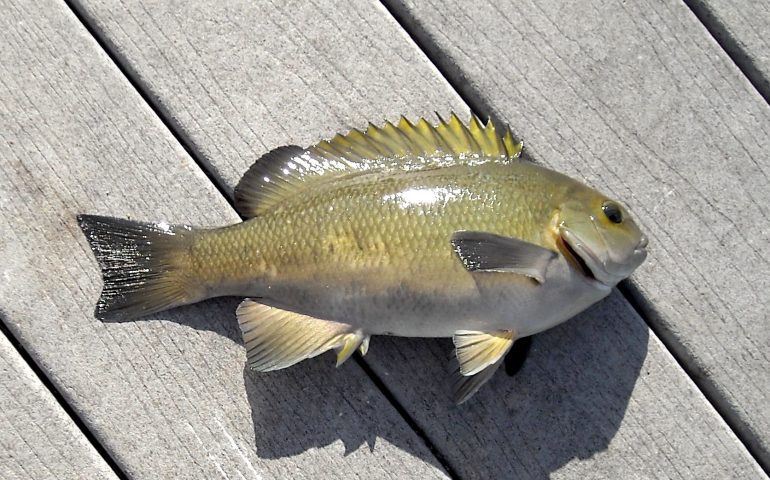
Sea Chubs: Family Kyphosidae
Species: Girella nigricans (Ayres, 1860); from the French word girelle (a derivative of julis, an old word used to denote a number of small wrasse in Europe), the Latin word nigr (dark) and the Greek word ikanos (becoming, in reference to its pleasing appearance).
Alternate Names: Blue-eye perch, green perch, opaleye perch, bluefish, blue bass, greenfish, Jack Benny, Catalina perch, button-back, button-eye, and button bass. Called chopa verde in Mexico.
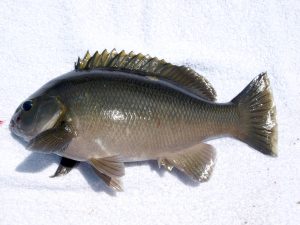
Identification: Opaleye are perch-shaped but heavier bodied. Their coloring is usually dark olive green, usually with two light spots at the base of the dorsal fin; occasionally pale green while some almost all white fish have been observed. Eyes are distinctive: large and an opalescent, blue-green color.
Size: To 26 inches and over 13 pounds. The California angling record fish weighed 6 lbs 4 oz and was taken near Los Flores Creek in Malibu in 1956. Another 6 Lbs 4 oz opaleye was reportedly caught by David Douglas at the Santa Monica Pier in 1964 (Pasadena Independent, January 16, 1964). It was never officially recorded. The diving record fish weighed 13 Lbs 7 oz and was speared by David Williams at Aliso, south Laguna Beach, in 1964. Unfortunately, most opaleye caught from piers are less than 14 inches in length.
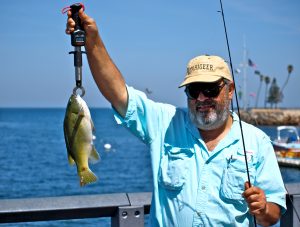
Mahageer (Hashem Nahid) and an opaleye from the Cabrillo Mole in Avalon
Range: Gulf of California (isolated population), and Pacific Coast from Cabo San Lucas, southern Baja California, to Otter Rock, Oregon. Common from Bahia Magdalena, southern Baja California, to Point Conception. Less common north of Point Conception and rare north of Monterey. A resident population does appear to have made a home at the Monterey Coast Guard Pier in Monterey. Surprisingly, the World Record Fish listed by the IGFA is from that isolated population, a 4 Lbs. 0 oz. fish that was caught on February 24, 2019.
Habitat: Generally found in intertidal, shallow-water, rocky areas and kelp beds. Recorded to a depth of 105 feet.
Piers: Can be caught from almost any pier in southern California located near rocks, reefs, or kelp. Less common north of Point Conception although taken occasionally at piers in Morro Bay. Uncommon north of Cayucos but a population seems established near the Coast Guard Pier in Monterey. Considered rare north of Monterey. Best bets: Shelter Island Pier, Ocean Beach Pier (inshore), Oceanside Pier, Oceanside Harbor Pier, Dana Harbor Pier, Cabrillo Pier (jetty side), the Green Pleasure Pier and Cabrillo Mole (Avalon), and Paradise Cove Pier. Most of the fish caught at SoCal piers are fairly small to mid-size opaleye. The exceptions are the two piers in Avalon that almost always have good-sized fish available for the opaleye-seekers.
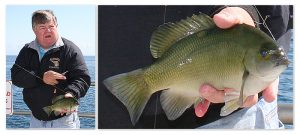
An opaleye I caught at the Cabrillo Mole
Shoreline: One of the main goals of rocky shore anglers in southern California.
Boats: An inshore species rarely taken by boaters unless targeting them at places such as jetties and breakwaters.
Bait and Tackle: Some anglers specialize in opaleye, and many of them swear that moss or frozen peas are the best bait. I’ve actually caught more on ghost shrimp but I must admit that I’ve watched, many a morning, while a group of opaleye “pros” from Los Angeles (I recognize them by now) caught opaleye after opaleye and they almost always use moss as their “bait du jour.” I think all three baits are excellent for opaleye (although the ghost shrimp are more expensive and sometimes hard to find). Fresh mussels, pile worms, bloodworm, and small rock crabs also make good bait. I also managed to hook a few opaleye using garden snails during an experiment testing different baits at Catalina in 2005.
Food Value: A very good eating fish that is mild flavored, small flaked, firm textured, and low in fat content. It is suitable for many forms of cooking but most commonly fried or steamed whole.
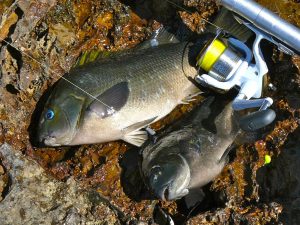
Opaleye caught from the rocks on the Palos Verdes Penninsula
Comments: Primarily herbivores (vegetarians), opaleye eat a variety of plants including feather boa kelp, giant kelp, sea lettuce and coralline algae. Evidently they also grab organisms attached to seaweed as they’re making their rounds, tasty little items like tube worms and red crabs. Opaleye are a favorite of many anglers; they’re hard to hook but once hooked put up a very good fight for their size.
The crystal-clear waters at Avalon present quite a challenge for the sagacious, line-shy opaleye. Big schools of 2-4 pound fish hang around the Green Pleasure Pier and the Cabrillo Mole but they can be very hard to catch. They seem more cautious of line at the Green Pleasure Pier but if you use a light line, perhaps 2-4 pound fluorocarbon, you might get them. (Actually, to be fair, I catch them every year at the Pleasure Pier and I usually am using 8-10 fluorocarbon). Of course the 1,794 ropes, tangled lines, pilings and yellow submarines that surround and hang under the GPP might also get your line.
At the Mole it’s the long fronds and blades of the giant kelp that sway (tidally) in or out near the railing. If the opaleye are allowed to encircle the kelp it’s pretty much over. As soon as they are hooked apply pressure and try to keep them coming toward you while having a person ready with a net. You need to use light line but can also pay the consequences if you’re unwilling to apply enough pressure.
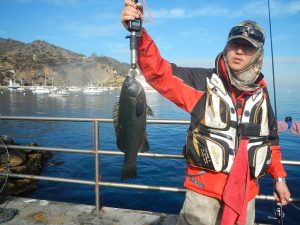
Big opaleye from the Cabrillo Mole
The opaleye “pros” who come over to Catalina from Los Angeles take the ferry over for one day, fish exclusively at the Mole, fish for one species—opaleye, and are almost always successful (coolers are crammed with fish). You learn from such experts and a few things should be mentioned.
The first is that the opaleye are typically at a mid-water depth, five to ten feet under the surface of the water depending upon the depth of the water. They are rarely caught on top and infrequently caught on the bottom (although I’ve caught several fishing on the bottom at night and they are often caught on the bottom by anglers casting out from jetties).
Second is that if you want to fish the correct depth a float is desirable and long slip-line floats are the preferred tackle for the opaleye hunters.
Third is when you see the float go down, strike and, as mentioned, try to keep the fish out of the kelp.
Fourth is that light line (preferably fluorocarbon) and small hooks (size 6 or smaller) are key.
Opaleye, especially the older, larger fish can be frustratingly difficult to catch. Chum with peas and a whole school may come up to check out the bait and fish after fish will approach the bait before turning away in seeming disapproval. But, the challenge of outsmarting the fish is part of the fun.
[…] Food Value: A very good eating fish that is mild flavored, small flaked, firm textured, and low in fat content. It is suitable for many forms of cooking but most commonly fried or steamed whole. Opaleye Pier Fishing in California […]
Many fishermen love opalye because they are difficult to catch but, if caught, fight quite hard for their size.
It’s been my hobby to go fishing with my friends. Is there a community i can join here?
Interesting read about opaleye! I’ve caught these before but never cooked them. Do you find their flavor pairs better with light citrus marinades or bolder herbs? Also, does their firm texture hold up well to grilling compared to other perch varieties? Would love to try a recipe with my next catch!
Share with interesting extracurricular activities. With the information you share, bring new knowledge values.
Definitely gonna try moss next time! Thanks for the info!
Never knew they were vegetarians.
Wow, this is a super helpful guide for opaleye fishing in California! I had no idea they liked moss as bait. Gotta try that next time I’m at the pier. Thanks for the tips!
Welcome to Games Hub – Play Free Online Games Instantly
Depending on the water depth, opaleye are usually five to ten feet below the surface. This is the first characteristic of mid-water.
Opaleye are such a challenge, but so rewarding! Moss and small hooks are definitely the way to go
Those secret spots for big opaleye in Avalon sound amazing! I’ve only caught small ones from piers.
It’s crazy how selective opaleye can be with bait! Always a fun puzzle to figure out what they want.
It’s a good spot to pause and learn about the many environmental elements that affect the bay’s health and the fisheries that depends on it.
It’s fascinating to learn about the opaleye and its diverse nicknames, like Jack Benny and button-eye! I didn’t realize how varied their appearance could be or that some have almost white coloring. The record sizes are impressive—especially the 13-pounder speared by David Williams. This reminds me of how catching rare fish in games like Bitlife can be a fun way to experience the excitement of discovery, just like real-life fishing.
I remember catching an opaleye, or Girella nigricans, during a fishing trip near Catalina Island. Its unique coloring really stands out in an aquarium, and the variety of names it goes by is interesting! When I’m not outdoors, I relax by playing Slope Game, which is a great way to unwind after a long day. Both activities help me appreciate the diversity in hobbies and nature.
The “cat distribution system” is a funny, internet-born term that describes how cats seem to randomly appear in people’s lives, as if the universe just assigns them to you when you least expect it. You didn’t plan to adopt a cat, but suddenly one shows up at your doorstep, in your backyard, or follows you home, and boom, you’re a cat owner. It’s like some invisible force decided it was your turn. People love this idea because it feels magical, spontaneous, and a little bit like fate (with fur).
this Opaleye guide is super helpful for my next pier fishing trip!
Sea Chubs, or opaleye perch, are a vibrant addition to marine life, boasting a plethora of names and a rich history in nomenclature. Their unique appearance and cultural significance reflect a diverse ecological tapestry. During a dive in California, I encountered a school of these stunning fish, reminiscent of a Block Breaker moment when unexpected beauty surfaces amidst the waves. Such encounters remind us of the ocean’s hidden treasures and the stories they tell.
Great post on Opaleye!
What a fascinating read! I had no idea about the ‘Opaleye pros’ or that they’re such a challenge to catch. Now I’m tempted to try for one myself.
Fascinating read—those opalescent blue-green eyes really do give the opaleye its name
WOW! so amazing
Really helpful content, appreciate you sharing!
i love it
Nice post. Thank you to provide us this useful information.
Simply wish to say your article is as amazing The clearness in your post is just nice and i could assume youre an expert on this subject Well with your permission let me to grab your feed to keep updated with forthcoming post Thanks a million and please carry on the gratifying work !
Great read. I’ve always found the central California coast to be the sweet spot for surfperch. Your point about the incoming tide is spot on—it makes all the difference in getting them to bite.
Great read. I’ve always wanted to try pier fishing in California, and your tips on bait and tides are really helpful. It sounds like a perfect way to spend a morning without needing a boat.
I appreciate the effort you put into writing this. Keep sharing!
Gemini said
It’s always a fun challenge trying to outsmart those line-shy opaleye with frozen peas or moss, especially when you manage to land one of those hard-fighting beauties from the rocks at Catalina.
Its like you read my mind You appear to know a lot about this like you wrote the book in it
This essay was entertaining and educational at the same time. Your willingness to share some of your original ideas is much appreciated. I’ll make sure my fellow fighters get this.
It’s always fascinating to learn about the etymology behind the names of different fish species. I had no idea “girelle” had such an interesting history! And those alternative names are quite a list; I wonder which ones are most commonly used by local anglers.
It’s always fascinating to learn about the etymology behind a species’ name. “Becoming” is such a lovely descriptor for the opaleye! I also love that it has so many interesting alternate names.
It’s so interesting to learn about the origin of their name and all the different names people call them! I had no idea they could get so large, either.
It’s always fascinating to learn about the origins of fish names, and the breakdown of Girella nigricans is particularly interesting. I never realized there were so many alternate names for this fish!
That’s a really interesting breakdown of the opaleye’s name origins! I always appreciate learning the etymology behind species names. It makes me look at them in a new light.
It’s always fascinating to learn about the etymology of fish names. The breakdown of “Girella nigricans” is really interesting, especially how “ikanos” relates to its pleasing appearance. I also love all the different alternate names for the opaleye!
It’s fascinating to learn about the origins of the opaleye’s name, especially the “pleasing appearance” part. I’ve always admired their distinctive eyes and the range of colors they can have. Thanks for sharing such detailed information!
It’s always fascinating to learn the origins of scientific names, and “Girella nigricans” has such a rich history! I love how the description highlights both its dark color and its “pleasing appearance.” What a beautiful fish!
This was a fascinating read about the opaleye! I had no idea they had so many different common names, and the etymology of their scientific name is really interesting. Great details about their appearance too.
I found the description of the opaleye’s distinctive blue-green eyes really interesting. It’s cool how a fish can have such unique features!
It’s really interesting to learn about the etymology of the name “Girella nigricans.” I always appreciate when articles dive into the history behind scientific names. And those alternate names are quite a list – “Jack Benny” definitely made me smile!
It’s always fascinating to learn the origins of fish names, and “Girella nigricans” definitely has an interesting linguistic background. The description of their distinctive opalescent eyes makes me want to see one in person!
It’s always fascinating to learn about the different names a single fish species can have, especially across languages. “Jack Benny” for an opaleye is a new one for me, and quite amusing!
It’s fascinating to learn about the various names for this fish! “Jack Benny” is definitely a new one for me, and it makes me wonder about the story behind that nickname.
It’s really interesting to learn about the etymology of “Girella nigricans.” I never knew the name had such a detailed origin story, connecting it to old French and Greek words. And all those alternate names for Opaleye are quite a list!
It’s always fascinating to learn about the origins of fish names, and “girelle” having roots in old European wrasse is really cool. I love how the description connects the Latin and Greek to its “pleasing appearance.” What a beautiful fish!
It’s really neat to learn the etymology behind the name Girella nigricans. I’ve always just called them opaleye and never thought about their scientific name. I also had no idea they could get up to 26 inches, that’s a big fish!
Wow, fascinating read! The description of these opaleye and how tricky they are to catch reminds me of learning anything new, really. Like trying to master a new skill or even sharing some knowledge – it’s all about timing. You can prepare, read all the advice, but sometimes the ‘fish’ just aren’t biting! It’s kinda like playing Doodle Baseball, haha. You gotta time that swing perfectly, and even then, you might strike out. But hey, each try teaches you something new about the ‘pitch’. Definitely makes you appreciate the small wins!
Wow, that’s fascinating! I never really thought about where scientific names come from. It’s cool how they combine different languages to describe the species. It kinda reminds me of those tense moments in agario – one minute you’re a small cell growing, the next you’re getting absorbed, ending up a meal for another player! I get the “dark” part there, the fear of being eaten is real!
I do trust all the ideas youve presented in your post They are really convincing and will definitely work Nonetheless the posts are too short for newbies May just you please lengthen them a bit from next time Thank you for the post
Wow, fascinating details about the Opaleye! I never knew they could vary so much in color. That bit about the opalescent eyes is particularly striking. It reminds me of how sometimes I stare at a Sudoku puzzle for ages, convinced I’ve got the solution, only to realize I completely missed a number. My eyes must glaze over just like those pale green fish! Gotta keep my brain sharp, just like those fish need sharp eyesight to spot food. Thanks for sharing these cool facts!
This is a fantastic resource on opaleye. I’ve been trying to target them more effectively from piers, and your insights into their habits and preferred baits are really helpful. It’s always a challenge to hear those subtle bites over the pier noise, but with a bit of practice and the right setup, it’s definitely achievable. Thanks for sharing such detailed information!
This was a fantastic read on Opaleye fishing! It’s always great to see such detailed information, especially for those of us who appreciate the nuances of different fish species. As someone who’s always interested in the cultural significance of names, it makes me think about how these fish are named and the stories behind them. Knowing more about the fish helps connect with the experience even further. Thanks for sharing such a helpful and informative article!
This is a fantastic and thorough guide on opaleye fishing. As someone who often has to weigh different options and make decisions, I appreciate the detailed insights into the best baits, rigs, and even the nuances of different seasons. It’s clear a lot of experience went into this, and it helps cut through the guesswork. Definitely bookmarking this for my next trip out.
This was a fantastic read on opaleye! As someone who’s always been fascinated by unique cultural connections, it’s interesting to think about how different regions approach fishing for these species. I’ve been exploring Chinese naming conventions lately, and it’s got me wondering if there are any interesting traditional names or folklore associated with fish like the opaleye in different cultures. Thanks for sharing such detailed insights into their habits and how to catch them.
I appreciate the detailed breakdown of opaleye habitats and the specific pier recommendations—it really helps narrow down where to focus efforts. The note about their distinctive opalescent eyes is a great identification tip for anglers.
I found the details about the opaleye’s distinctive opalescent eyes and color variations quite fascinating. It’s helpful to know they’re most common near rocky areas and kelp beds in southern California.
Ecologically, they play a useful role in controlling algal growth in nearshore habitats, which helps maintain balance in kelp ecosystems.
I totally get the stress of optimizing every second. Remember in Papa’s Pizzeria when you’d get, like, three orders at once, all with crazy toppings? I used to get so flustered, burning pizzas left and right trying to satisfy those ridiculously picky customers. It was a disaster! I agree that these games are definitely addictive, but sometimes I think they reflect real-life pressure a little too well, haha! Still fun, though.
I appreciate the effort you put into writing this.
It’s always fascinating to learn about the different names a single fish species can have, especially across languages. “Jack Benny” for an opaleye is a new one for me, and quite amusing!
That’s wild! “Jack Benny” for a fish – never heard that! Makes me think of Omegle, how you never know what name (or who) you’ll stumble across. Some are hilarious, some are… interesting, to say the least. Definitely keeps things fresh!
Thanks for starting this thread—lots of good input here.
I never knew the origin of the name Girella nigricans before reading this. It’s interesting how language influences species names. The reference to its pleasing appearance makes sense given how lovely they are in the water. I’ve seen them while snorkeling and their colors are really beautiful.
I enjoy the unique challenge of targeting opaleye from the rocks and pilings because their selective, herbivorous diet makes them an incredibly rewarding catch for any patient angler.
Thank you for the auspicious writeup It in fact was a amusement account it Look advanced to far added agreeable from you However how can we communicate
The mention of using frozen peas as bait for opaleye is fascinating – I have never heard of anyone using vegetables for saltwater fishing but it makes sense if that is what they naturally feed on near kelp beds. That experiment with garden snails at Catalina in 2005 shows some real dedication to testing different baits. The resident population at the Monterey Coast Guard Pier is an interesting case of adaptation. I also find it funny that those opaleye pros from LA always use moss – sounds like they have it down to a science. The food value note at the end is a nice bonus for anyone wondering if they are worth keeping.
Interesting read! I had no idea opaleye were herbivores. The details about their habitat and bait are very helpful for a beginner like me.
Great article! I’ve always wondered about the best bait for opaleye. The tip about using moss is really helpful. I’ll definitely try that next time.
The tip about using frozen peas for opaleye is surprising! I’ll have to try that on my next trip. Thanks for the comprehensive guide.
That’s fascinating! I always learn something new about marine life. The description of its distinct opalescent, blue-green eyes makes me wonder if there’s a Geometry Dash level designed with a similar visual theme. Could be a cool challenge to navigate!
What a fantastic deep dive into Opaleye! I always appreciate learning about the different names and identifying features. It’s especially interesting to see the record sizes caught, truly impressive. This kind of detailed content makes me want to grab my fishing rod! And speaking of details, for anyone who enjoys converting visual information into structured data, I’d
Great tips on targeting opaleye from the pier. I’ve had mixed luck using moss for bait, but I’ll try the setup you described next time. Do you find they’re more active on the early morning low tides, or does time of day matter less for this species?
This is a great topic, thanks for sharing.
Thank you for such an informative article! does time of day matter less for this species?
I benefited greatly from the information in this post. Thank you.
Great read! I’ve tried pier fishing in Southern California a few times, but never targeted opaleye specifically. Do you find that they’re more active during certain tide conditions, or is it mostly about having the right bait?
Very helpful. keep up the good work. many thanks
The mention of an almost all-white opaleye caught my attention—it makes the typical dark olive coloring feel like a choice, not a rule.
CalcSolver is a handy online calculator platform that offers fast, accurate, and easy-to-use calculation tools for everyday tasks. Whether you need financial, math, health, or conversion calculators, Calculator users can quickly find reliable results in one place.
I had no idea opaleye were vegetarians — using frozen peas as bait is a clever trick. I’ll keep an eye out for those blue-green eyes next time I’m near a kelp bed.
Appreciate the insights shared here.
This Opaleye overview is practical for pier anglers—habitat notes, feeding habits, and how they behave around structure all help when deciding where to spend time on the rocks. I appreciate the California-focused detail instead of generic fish facts.
I had no idea opaleye could vary so much in color while still being identified by those distinctive blue-green eyes. The comparison between moss, frozen peas, and ghost shrimp is especially useful, as is the explanation of why rocky areas and kelp near Southern California piers are the best places to target them.
You are good to have these amazing pictures of the fishing for Opaleye and it is a great adventure. When I first visited here, I saw you have the best solutions for us and we can use it to get the desired places where we want to go fishing.
You are good to have these amazing pictures of the fishing for Opaleye and it is a great adventure. When I first visited here, I saw you have the best solutions for us and we can use it to get the desired places where we want to go fishing.
Great read on the opaleye! I have had the best luck with them at the Avalon piers, and you are right that the fish there run noticeably bigger than at most SoCal spots. The detail about their striking blue-green eyes was a nice touch.
Opaleye are such a fun and unique species to target off the piers! Their fight relative to their size is always impressive, and finding the right spot with plenty of kelp and algae really makes all the difference. Thanks for breaking down the habitat, bait choices, and techniques so thoroughly—great read for any coastal angler!
Casual
I think mobile gaming works best when the interface is simple and you can understand the options without spending too much time figuring things out. The Goa game app seems to be discussed mainly for its variety of games and easy mobile access. I would still check the rules, costs, and availability in my area before using any real-money gaming service.
The mid-water detail explains why bait choice alone is not enough for opaleye. A slip float keeps peas, moss, or shrimp in the five-to-ten-foot zone, while light fluorocarbon addresses how cautious these fish can be in Avalon’s clear water. The tradeoff is fascinating: tackle must be subtle enough to earn the bite, but the angler still has to apply immediate pressure before the fish reaches kelp or pier structure.
Great article on Opaleye! These fish can be tricky to catch off the pilings, but they’re always a blast to target once you find the right setup and bait. Appreciate the helpful tips!
Mình đánh giá ott watch for pikashow khá cao vì tốc độ tải game rất mượt. TONY08-18
Really interesting guide. I had no idea frozen peas or moss could be such effective bait for opaleye. The tips about keeping them out of the kelp and using lighter line were especially helpful. Sounds like they put up a pretty good fight for their size!
I have had great success using frozen peas for opaleye at the Cabrillo Mole in Avalon, but I will definitely have to try using moss next time I head out. Since I bring home quite a bit of fish to clean and freeze, I have been planning to renovate a utility room in my house into a dedicated gear storage and fish processing station. I ended up using a room size calculator to figure out the exact square footage for the new waterproof flooring and how much waste to account for, which made planning the project a lot easier.
I didn’t realize “opaleye” had so many alternate names, especially odd ones like Jack Benny and button-eye. The breakdown of Girella nigricans is also interesting, since the “dark” and “pleasing appearance” roots fit the fish pretty well.
オパールアイの学名が、フランス語の girelle やラテン語の「暗い」、ギリシャ語の「好ましい姿」に由来するとは知りませんでした。ブルーアイパーチやジャック・ベニーなど別名が非常に多く、地域ごとの呼び方を調べるのも楽しそうです。
The long list of common names is fascinating, especially “Jack Benny” and “button-back,” which feel much less expected than opaleye or green perch. I also enjoyed the breakdown of Girella nigricans—particularly how the Latin and Greek roots connect the scientific name to the fish’s dark coloring and pleasing appearance.
Excellent overview of targeting Opaleye! They can definitely be picky biters compared to other pier species, so using frozen peas or moss as bait makes all the difference. Really appreciate the detailed terminal rig advice and location tips!
Download YouTube thumbnails online in HD quality for free. Get YouTube video thumbnails in 4K, 1080p Full HD, 720p, HQ & SD resolutions