Skates: Family Rajidae
Species: Raja binoculta (Grard, 1855); from the Latin words raja (skate), bi (two), and oculata (eyed, referring to the markings on top of the skate).
Alternate Names: Skate, barndoor skate, and Pacific great skate. Called raya gigante or raya bruja gigante in Mexico.
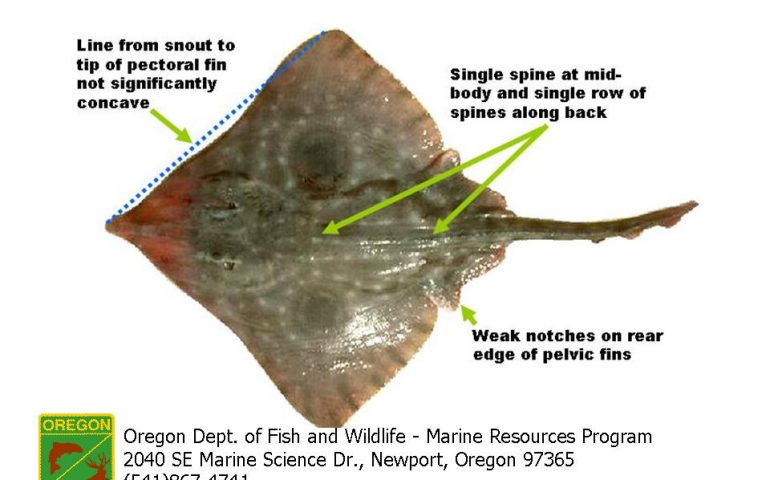
Identification: The only skate with a notch in the rear edge of each pelvic fin. The nose is long, bluntly pointed, and broadly triangular. The body is flat with two separate dorsal fins near the end of the tail. Their coloring is gray, brown, reddish brown, olive brown, or blackish, with smaller white spots and two prominent eyespots above; whitish with a possibility of dark spots below.
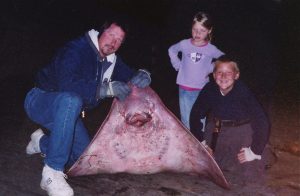
Size: Reaches eight feet in length and to over 200 pounds. Those caught at piers rarely exceed 100 pounds in size although two big skates, one at the Cayucos Pier in July 2004 (estimated at 5 feet by 5 feet) and another one taken at the Trinidad Wharf in the summer of 1996 (4 1/2′ wide and 5 1/2′ long), seemingly were over the century mark.
Range: Cabo Falsa, southern Baha California, and Gulf of California, to the East Bering Sea and Aleutian Islands, at least west to Unalaska Island; also eastern Gulf of Alaska. Considered common Gulf of Alaska to southern California although rarely seen south of Point Conception.
Habitat: Generally found in water of moderate depth although ranges from the shallows to a depth of at least 1,640 feet and possibly 2,624 feet; luckily for pier fishermen, they’re also found over sandy-shore beaches and in bays.
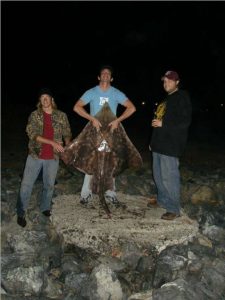 Piers: A few are caught each year, generally at piers north of Point Conception. Best bets: Pismo Beach Pier, Morro Bay Wharf, Cayucos Pier, Seacliff State Beach Pier, Santa Cruz Wharf, San Francisco Municipal Pier, McNear Park Pier, Fort Baker Pier, Pacifica Pier, Trinidad Pier, Del Norte St. Pier (Eureka) and the B St. Pier (Crescent City).
Piers: A few are caught each year, generally at piers north of Point Conception. Best bets: Pismo Beach Pier, Morro Bay T-Piers, Cayucos Pier, Seacliff State Beach Pier, Santa Cruz Wharf, Pacifica Pier, San Francisco Municipal Pier, Paradise Park Pier, McNear Park Pier, Fort Baker Pier, Del Norte St. Pier (Eureka), Trinidad Pier, and the B St. Pier (Crescent City).
Shoreline: An occasional catch for northen California fisherman in Humboldt and Arcata Bay.
Boats: A few are reported from boaters and kayakers fishing in Humboldt and Arcata Bays.
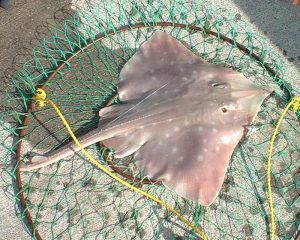 Bait and Tackle: Due to their potential size, medium to heavy tackle should be used. However, most biggies are caught by anglers seeking other species, few anglers fish specifically for skates. Most any bait will tempt a skate but squid, clams, ghost shrimp, marine worms, and small fish seem to work best.
Food Value: Like guitarfish, skates when used for food are really delicious. They have a firm texture with no apparent flakes and a mild taste. The fat content is low. In Europe, where skates are considered a delicacy, the fillets (from th wings) are usually poached, steamed or pan-fried in butter. Anothr method is to cut off the skin around the wings and then use cookie cutters to punch out pieces of meat that are somewhat similar in taste and texture to scallops. Many stories tell of skate being sold in stores as scallops but some experts say that it is doubtful, that the differences are two pronounced. Deep-frying is the most common method of cooking for skate prepared in this manner.
Comments: Far less common than bat rays but the average big skate taken is fairly good size. According to the CA DF&G, “skates have paired electric organs along the sides of their tails, which generate weak, low-voltage electric currents believed to be of use in intra-specific communication, possibly for mate recognition or to demonstrate aggression. These electric currents are not harmful to humans.”
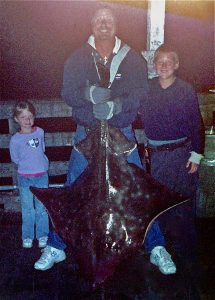
Big Skate—Although fairly uncommon, the ones that are caught are often large in size.
≈ 200 Lbs. — Redondo Pier No. 2, Il Sherard, January 12, 1918
Source: Los Angeles Times, January 13, 1918
≈ 150 Lbs. — Hotel Del Coronado Pier, December 19, 1898
Source: Los Angeles Times, December 19, 1898
130 Lbs. — Capitola Wharf, Early 2000’s
Source: Capitola Wharf Bait Shop
109 Lbs. — Hermosa Beach Pier, Osborne Schmidt, August 8, 1936
Source: Los Angeles Times, August 9, 1936
≈ 100+ Lbs. — Cayucos Pier, July 2004 (100+ pounds, 5” wide and 5’ long)
Source: Glenda, The Tidepool B&T, Cayucos
≈ 100+ Lbs. — Trinidad Pier, Rosie, March 1997 (100+ pounds, 4 ½’ wide and 5 ½’ long)
Source: Salty’s Bait and Tackle, Trinidad
≈ 100+ Lbs. — Princeton Pier, Ray Blair & Albert Frush, October 23, 1932
Source: San Mateo Times, October 25, 1932
≈ 100+ Lbs. — Santa Cruz Wharf, Nick Bosano, June 30, 1932
Source: Santa Cruz Sentinel, July 1, 1932
≈ 100+ Lbs. — Santa Cruz Wharf, March 26, 1931
Source: Santa Cruz Evening News, March 27, 1931
≈ 100 Lbs. — Railroad Wharf (Santa Cruz), W. R. Manning, November 19, 1900
Source: Santa Cruz Evening Sentinel, November 20, 1900
95 Lbs. — Morro Bay North T-Pier, December, 1999
Source: Pier Fishing In California
93 Lbs. — Santa Cruz Municipal Wharf, April 1926
Source: Santa Cruz Sentinel, April 10, 1926
75 Lbs. — Santa Cruz Municipal Wharf, February 14, 1933
Source: Santa Cruz Sentinel, February 15, 1933
75 Lbs. — Seacliff Pier, J. Bligh, March 1931
Source: Santa Cruz Sentinel, March 25, 1931
My husband and I just caught a skate longer then me ” I,m 5″3″ and about 125 lbs The wings alone were around 100 lbs.’ We were fishing off the jetty in Westport WA.’
Carol, It certainly sounds like a big skate. Did you get any pictures?
Best wishes, Ken
a close friend landed one at the Imperial Beach Pier in San Diego
What’s up, this one came from a taxi driver who talked nonstop about luck and stupid decisions. Later that night in canada, I checked it out. Right in the middle of exploring I ended up on Casino Rama. The vibe was rough and honest. Slots screamed, tables got tense, and players vented freely. I liked that chaos. I lost a bit, won a bit, and felt like the night wasn’t wasted, which is all I really expect.
Hallo! Ich suchte nach einer einfachen und unkomplizierten Beschäftigung und entschied mich für Duospin. Alles ist sofort verständlich, und es ist einfach und angenehm zu spielen. Ganz ehrlich: Es ist definitiv einen Versuch wert, um sich eine entspannende Pause zu gönnen. Manchmal hatte ich Glück, manchmal nicht, aber insgesamt war es eine positive Erfahrung. Ich bin sehr zufrieden und kann es weiterempfehlen.
Greetings from Brisbane. I found this online casino through a banner ad while reading sports news and clicked through to the Mateslots Australia homepage. The layout felt straightforward, with quick links to pokies and promotions. I liked that everything was displayed in AUD, which made budgeting easier. After a few exploratory spins, I hit a modest win that made the evening far more exciting than I expected.
wild how big these skates can get, and that pelvic fin notch detail is something i’d never heard before. i’ve only tangled with smaller ones off santa cruz and it still felt like dragging a wet rug. i also appreciate the note about the weak electric organs; i always wondered if handling them was risky. weird side note: after a long pier session i ended up doom-scrolling gambling lists at megaballgame and it felt as off-topic as the casino spam replies here. the same night i clicked playcashorcrash and fortune-roulette and it just made me miss reading actual fish reports instead of random promos.
Subscribed instantly after reading this.
I love the structure of your explanation.
The examples really helped.
Me gusta poner música así cuando estoy despierto tarde trabajando o simplemente relajándome online. De hecho conocí Casea Casino ES crazytower-es.com/ en una noche parecida porque un amigo me lo pasó mientras escuchábamos sets electrónicos. Desde entonces entro de vez en cuando porque tiene juegos rápidos y bastante entretenidos.
Điều mình thích là hb88 uy tín số 1 phản hồi nhanh khi thao tác liên tục. TONY06-25
Mình thường ưu tiên những nơi có giao diện đơn giản và hiện tại slot365 com đáp ứng khá tốt điều đó. TONY06-25
Helpful species profile. The note about big skates reaching over 200 pounds, plus the specific pier records, makes this especially useful for turning a fishing talk or field video into searchable notes.
The game removes barriers between people and musical expression.
The medium-to-heavy tackle recommendation is practical, especially alongside the specific bait list of squid, clams, ghost shrimp, marine worms, and small fish; it gives a fishing group a clear way to divide preparation before heading to the pier. We use that same step-by-step teamwork with Pips Hint during a daily NYT Pips break, but which bait has worked most reliably for your local skates?
The TBC Talent Calculator helps plan optimal talent builds for raids.
The bait-and-tackle section’s recommendation of medium-to-heavy tackle, while noting that many big skates are caught incidentally, suggests two practical workflows: a species-specific rig checklist or a broader pier log that records whatever takes the bait. I’d keep the latter in a Markdown note and use MD Viewer’s live preview to turn the bait, depth, and pier details into a quick field card. Next I’ll draft that checklist before my next trip.
As a first-time skate reader, I agree that medium-to-heavy tackle is sensible because a big skate can top 200 pounds, but the tradeoff is carrying comically serious gear when most pier anglers are targeting other species. The non-obvious lesson is that “almost any bait” still leaves a practical choice among squid, clams, ghost shrimp, marine worms, and small fish. I’m using Townscaper to sketch a tiny pier scene for a current community fishing display—no fish AI required. For a first trip, would you start with squid or ghost shrimp?
Could the recommendation for medium-to-heavy tackle coexist with the warning that most big skates are accidental catches? If I were logging a weekend at a pier, I would keep the heavy setup ready but use a random number wheel to assign bait or spot rotations, then compare results without assuming the skate can be targeted reliably. That tradeoff could show whether preparation matters more than species-specific targeting.
I have seen plenty of bait lists, but the detail that big skates are usually incidental catches sharpened my view: the useful skill is choosing a deliberate test when the outcome is uncertain. If I were working a sandy bay with medium-heavy tackle, I would start with squid rather than switch after every missed bite, then judge whether my forecast was right. That is the same discipline needed whenever you commit to an exact result before the score is known.
I once treated a shared fishing plan as if any bait and any rod would work, but the guide’s point is more precise: ordinary bait may tempt a skate, while a deliberate target still requires medium-to-heavy tackle and coordinated handling. I would give each teammate a defined role and use a short Spades Game round as a low-stakes way to test partnership decisions before the next large-fish attempt, because consistency matters more when the catch can exceed 100 pounds.
The note that big skates can range from the shallows to at least 1,640 feet is easy to miss beside the pier recommendations, and it makes the sandy-beach habitat claim feel more conditional than the catch list suggests. A skate reported from a bay or kayak could therefore be a better test case than a routine pier catch, although I would still want to separate depth, tide, and bait before treating those locations as equally promising. I keep a quick single-player Hearts Game round open while comparing those variables between trips, then I’ll log the next catch against tide and bait.
The article’s 200-pound maximum and the note that pier-caught skates rarely exceed 100 pounds make the practical takeaway clear: expected catch size should determine the gear, not the species name alone. If I were planning a current shoreline field guide, I would use that range to build a simple size-based decision flow, provided local pier and bait conditions are checked first. That same block-by-block workflow is why I can see Oskarstalberg fitting a project mockup, letting a team test small island-town layouts before committing to a final design.