

Order Scorpaeniformes
Scorpionfishes and Rockfishes — Family Scorpaenidae
Genus Scorpaena — California Scorpionfish
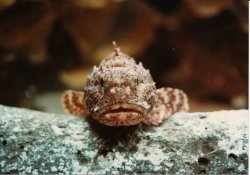
Whatcha looking at?
Scorpionfishes and Rockfishes — Family Scorpaenidae
Genus Scorpaena — California Scorpionfish
Whatcha looking at?
Species: Scorpaena guttata (Girard, 1854); from the Greek word scorpaena (scorpion, referring to the poison spines), and the Latin word guttata (a form of small drops or spotting).
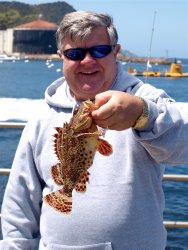
A small scorpionfish I caught one day at Catalina.
Alternate Names: Commonly called sculpin although not in the sculpin family of fish. Also called scorpionfish, scorpion, little poker, and scorpene. Early records show stingfish and spinefish as favorite appellations. An early name used in Redondo Beach to reflect their colors and large fins was “Redondo Butterflies.” In Mexico they’re called escorpión Californiano.
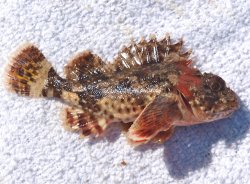
A scorpionfish caught one day at the Oceanside Pier
Identification: Typical rockfish shape, heavy-bodied and with strong head and fin spines. Their coloring is red (deeper water) to brown (more shallow water) with dark spotting over the body and fins. Fin spines are venomous and can cause a very painful, although not fatal, wound.
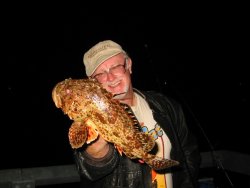
A scorpionfish caught by my friend Boyd Grant
Size: To 18.5 inches, although most caught from piers are less than 12 inches long. The California record fish weighed 3 Lbs. 2 oz. and was caught at Newport Beach in July 2022. The IGFA World Record fish is listed at 5 Lbs. 0 oz. and was taken at Rocky Point, Palos Verdes, in June of 2024.
Range: Uncle Sam Bank, central Baja California, and the Gulf of California, to Santa Cruz, California. They are uncommon north of Point Conception.
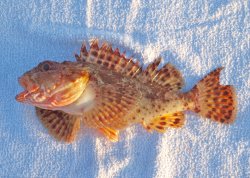
A scorpionfish missing part of its tail
Habitat: Most abundant in shallow rocky environments such as rocky reefs, sewer pipes and wrecks; frequently found in caves and crevices. Some are also found on sand. Found in intertidal, fairly shallow water down to 626 feet. May travel over 200 miles in annual spawning migrations (spring and early summer) that see them form large spawning aggregations on or near the bottom (at a variety of depths). Considered a nocturnal species that feeds mostly at night.
Piers: Although scorpionfish are most common around rocky areas and reef areas, I have seen them caught at almost every oceanfront pier in southern California. Best piers are the two piers in Avalon, the Cabrillo Mole (No. 1 in the state) and Green Pleasure Pier (No. 2 in the state). The best mainland piers are Shelter Island, Oceanside, San Clemente, Newport, Balboa, Redondo Beach, Hermosa Beach, Santa Monica and Stearns Wharf in Santa Barbara.
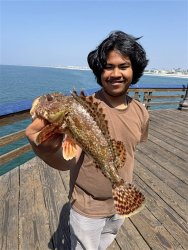
A scorpionfish from the Imperial Beach Pier.
Shoreline: Occasionally caught by shore anglers fishing rocky areas in southern California.
Boats: A common catch by boaters in southern California.
Bait and Tackle: Scorpions are carnivorous, ambush predators that are primarily nocturnal, feeding at night. Their main diet consists of small crabs, octopus, shrimp, and small fish. A high/low leader with size 4 hooks baited with squid or shrimp seems to work best although they also really like ghost shrimp. Still, I’ve caught them on cut anchovies, strips of mackerel, pile worms, and one on a live queenfish that seemed almost as large as the scorpionfish thatdecided to eatb it. They’re not too discriminating as far as food.
Food Value: An excellent eating, mild-flavored, and densely textured fish that is low in fat content. I like it fried although they are a favorite fish for sushi, and are often steamed whole; they command top prices when fresh fish are available.
Comments: Handle with extreme care since they are the most venomous member of the family found in California. If handled in a careless manner and a puncture wound does occur there will usually be pain (sometimes intense) and perhaps swelling that should subside after a few hours. If possible, soak the affected area in hot water as soon as practical (since the hot water alters the toxin and makes it less harmful). Multiple punctures may require doctor's attention or even hospitalization. The worst story I ever heard of such multiple punctures concerned a middle-aged angler fishing from a boat near Catalina. This lady had caught upwards of a dozen scorpionfish that were dutifully deposited into her gunnysack. Unfortunately, many of the long spines were protruding from her bag when a heavy wave caused her to lose her footing and to fall, bottom-first, onto the bag. The result was butt-porcupine and a helicopter trip back to a hospital.
Additional advice comes from a post by “Paul Grunion” to the PFIC Message Board. Paul, actually Paul A. Gregeory, a marine biologist with the California Dept. Fish and Wildlife: “Sculpin can be lipped to remove the hook. if you are going to keep them, you can cut off the dorsal and anal spines with diagonal cutters (dikes) or shears. It is best to do that, because they live a long time out of water and many anglers are stung when they go to clean them and they give a final flip. If you get stung, the best treatment is soaking the wound in water as hot as you can stand and putting meat tenderizer on the wound and rubbing it in. Meat tenderizer is also good to put on stings from stingrays and jellyfish.”
Although studies showed a decline in population before 1980, they seem to have increased and today have a healthy population.
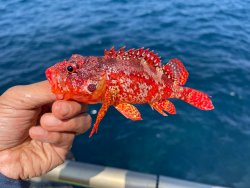
A rainbow scorpionfish caught at Catalina
A closely related species, is the brighter colored rainbow scorpionfish, Scorpaenodes xyris. It is occasionally seen in California although considered uncommon. It’s more common from central Baja south.
Attachments
-
 2.3 MB Views: 0