

Got a report this morning on our sister site, Pier Fishing In California Facebook page. It was a report from Mark Jury who said he caught a tripletail surf fishing next to the Belmont Pier in Long Beach.
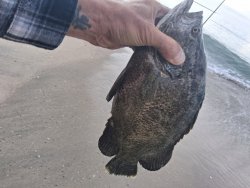
I replied that it was a rare catch. We have only had, as far as I know, two Pacific tripletail, Lobotes pacificus, caught at California over the years. The first catch was from the Balboa Pier in September 1997. The second was the fish pictured below, a fish caught in October 2014 from the Oceanside Pier.
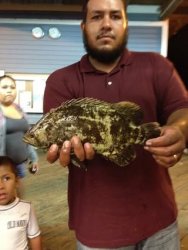
I then checked a paper on El Nino fish: OBSERVATIONS ON FISHES ASSOCIATED WITH THE 1997-98 EL NINO OFF CALIFORNIA, ROBERT N. LEA & Richard H. Rosenblatt, California Department of Fish and Game, Marine Division.
Lobotidae — Lobotes pacificus, Pacific tripletail, was first reported from California (as Lobotes suvinamensis) from a single specimen taken off the Cabrillo Breakwater, Los Angeles Harbor, on 5 April 1992 (Rounds and Feeney 1993). The tripletail was caught by a recreational angler and measured 533 mm TL. In the intervening period to the 1997-98 El Niiio we are aware of no other captures of this species. During the 1997-98 El Nino event, at least six Pacific tripletail were taken off southern California. On 23 August 1997 a Pacific tripletail was caught 22 km south of Dana Point, Orange County. The fish measured 384 mm TL and was caught by an angler fishing on drift kelp at the surface. On 2 September 1997 a tripletail was caught off Balboa Pier, Orange County, and on 6 September 1997 a third tripletail, measuring 461 mm TL, was caught from the beach at Belmont Shore, Los Angeles County. Additionally, three specimens were captured from south San Diego Bay between 5 November 1997 and 1 January 1998 by Mike Irey, a commercial fisherman targeting mullet and corvina. All of the tripletail captured were relatively large adults ranging in size from 384 to approximately 700 mm TL. Tripletail are known to associate with flotsam such as floating debris, trees and logs, and floating kelp. We assume this to be the mechanism of transport for those individuals reaching southern California waters. Larvae of Lobotes have not been identified from the CalCOFI sampling area (Watson 1996).
I replied that it was a rare catch. We have only had, as far as I know, two Pacific tripletail, Lobotes pacificus, caught at California over the years. The first catch was from the Balboa Pier in September 1997. The second was the fish pictured below, a fish caught in October 2014 from the Oceanside Pier.
I then checked a paper on El Nino fish: OBSERVATIONS ON FISHES ASSOCIATED WITH THE 1997-98 EL NINO OFF CALIFORNIA, ROBERT N. LEA & Richard H. Rosenblatt, California Department of Fish and Game, Marine Division.
Lobotidae — Lobotes pacificus, Pacific tripletail, was first reported from California (as Lobotes suvinamensis) from a single specimen taken off the Cabrillo Breakwater, Los Angeles Harbor, on 5 April 1992 (Rounds and Feeney 1993). The tripletail was caught by a recreational angler and measured 533 mm TL. In the intervening period to the 1997-98 El Niiio we are aware of no other captures of this species. During the 1997-98 El Nino event, at least six Pacific tripletail were taken off southern California. On 23 August 1997 a Pacific tripletail was caught 22 km south of Dana Point, Orange County. The fish measured 384 mm TL and was caught by an angler fishing on drift kelp at the surface. On 2 September 1997 a tripletail was caught off Balboa Pier, Orange County, and on 6 September 1997 a third tripletail, measuring 461 mm TL, was caught from the beach at Belmont Shore, Los Angeles County. Additionally, three specimens were captured from south San Diego Bay between 5 November 1997 and 1 January 1998 by Mike Irey, a commercial fisherman targeting mullet and corvina. All of the tripletail captured were relatively large adults ranging in size from 384 to approximately 700 mm TL. Tripletail are known to associate with flotsam such as floating debris, trees and logs, and floating kelp. We assume this to be the mechanism of transport for those individuals reaching southern California waters. Larvae of Lobotes have not been identified from the CalCOFI sampling area (Watson 1996).