

Remember the puffers caught at the Redondo Beach Pier (2026) and Seal Beach Pier (2023)? DO NOT EAT THEM!
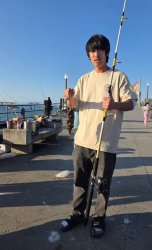
Bullseye Puffer caught at the Redondo Beach Pier on January 24, 2026
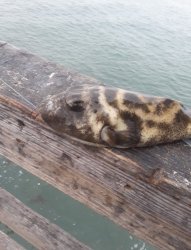
A bullseye puffer caught at the Seal Beach Pier in 2023.
A press release from the CA. Dept. of Fish & Game, Oct. 9, 1984
For the Thrill and the Agony, Consider the Puffer.
Two longnose puffer fish, only the third and fourth ever reported taken from California waters are alive and well at Marineland of the Pacific, Los Angeles, after being caught four hours apart off the Redondo Pier on Sept. 29. Marineland plans to display them on its Baja Reef. The puffers—they could be deadly—have been identified by state Department of Fish and Game marine biologist Mike Harris.
Internal organs of many puffer fish contain a poison tetrodotoxin-well known in Japan where t h e puffer is esteemed as a dangerously delightful delicacy known as fugu. In one 71-year period, from 1893-1963, 10,745 cases of fugu poisoning were reported in Japan, resulting in 6,386 deaths, a fatality rate of 59.4%.
“A Field Guide t o Pacific Coast Fishes of North America” includes the statement that the species of puffer fish found in the northeast Pacific are not known to be toxic. But Dr. Findlay E. Russell in “Advances in Marine Biology” lists the Sphoroides lobatus—that’s the longnose—as one of those species responsible for tetrodon poisoning. Another, the bullseye (Sphoroides annulatus)—reported taken twice from San Diego ocean waters in the latter half of t h e 19th Century is also listed in the poisonous category by Russell.
The late John E. Fitch of t h e California Department of Fish and Game reported a longnose puffer taken off the Redondo Pier on Dec. 23, 1972, by an angler using a live anchovy for bait. That fish was also given to Marineland. Fitch said a fish caught in the vicinity of San Pedro on May 15, 1941, appeared t o have been a longnose, but identification was not certain. That puffer was given to the Cabrillo Beach Marine Museum, San Pedro. Fitch wrote that there was some difficulty in distinguishing between the longnose and the bullseye puffer, the extent of the snout being one of the principal differences. He said one bullseye was caught in San Diego i n 1857 and another sometime prior to 1880. Once one has become well acquainted with the two species, identification is simplified. The bullseye has concentric rings on its back t h a t give it its name. And if you ever look at a longnose straight-on there would be no mistake about identifying it. The bullseye grows to about 15 inches and the longnose to 10 inches. The two longnose puffers caught on Sept. 29 were mature adults, the largest 9-incher caught on squid by Scott McKelvey, an employee of the Redondo Beach landing. The other was caught by James Sanders of Woodland Hills. Both fish were initially identified by Dan Armstrong, manager of Redondo Sportfishing.
Why al the concern? Information Bulletin No. 12, published by the A i r Training Command, Maxwell Air Force Base, Alabama, has some advice on the puffer and tetrodotoxic fish poisoning: “The toxicity is variable and is thought to be influenced by the reproductive cycle and possibly feeding habits. The gonads, intestines and skin are the most toxic parts. “Tetrodotoxin occurs only in the order Tetraodontidae, which includes the puffers, the porcupine fish and the sunfish or molas.
“Tetrodotoxin is one of the most violent fish toxins known. Most common symptoms are tingling about the lips and tongue, and, later, the rest of the body, motor incoordination, salivation, weakness, nausea and vomiting, diarrhea and abdominal pain, muscular twitching, paralysis, convulsions, and death by respiratory paralysis. The reported fatality rate is 60%. “Therefore these fish should never be eaten,” the report concludes.
The warning is echoed in Dr. Bruce W. Halstead’s massive work, “Poisonous and Venomous Marine Animals of the World,” written for the U.S. Department of Defense. “From the viewpoint of preventing tetrdon poisoning no one has ever improved on the ancient Mosaic sanitary laws,” Halstead says. “Eliminate all scale fish from the diet.” He explained further that the puffer was perhaps the poisonous fish best known to the ancient Israelites. Halstead also points t o the presence of tetrodon in two other fish commonly encountered in California waters—the oceanic puffer (agoce hlagocephalus-) and the mola mola, or sunfish. One further warning on the later; nothing good could ever come out of anything which subsists principally on a diet of jellyfish. Halstead mentions a 1706 incident in Baja California. He cites Clavijero’s history: Four soldiers were poisoned by eating the liver of a “botete,” or bullseye puffer, which they took from the Gulf of California. One soldier died in 30 minutes; another died a short time later; a third, who had merely chewed the liver, lost consciousness on the following day, and the fourth, who barely touched it was sick for several days.
Halstead does mention, however, that knowledge regarding species of the tetrodontiform fishes exclusive of Japanese forms is meager, although many of t h e tropical species have produced violent deaths at one time or another. He says: “Unless a species is definitely known to be nontoxic, which is questionable even under the best of circumstances, all tropical forms should be eliminated from the diet.
Puffers have had their puffery. An article in the August, 1984, issue of National Geographic comments on t h e addiction—one would almost have to call it that—of some Japanese to fugu, or puffer fish. “Cut up and served in a restaurant, it can bring $200,” the article states. The article also states that “In Japan, eating fugu has been the gastronomic version of Russian roultte for centuries.” Why do people take such chances? Well, a dish of featherthin slices shaped into a chrysanthemum bloom is a delight to the eye, and the palate as well— it‘s assumed. And Halstead notes that Japanese researchers (Mizukawa 1912 and Itakura1917) have written that tetrodoxin ameliorates conditions of impotence. Itakura observed, f o r example, a startling development among rabbits. Certain other values of the puffer were known long before that. Halstead said that Klou Tsung-sliih, writing in the Sung Dynasty (A.D. 960) remarked on the use of puffers in the treatment of sciatica (pain in the lower back, buttocks or hips). And it is interesting to learn that herbalists of the same period used the poison of the newt for treatment of the same ailment. But it was not known until 1964 that chemists learned that the two substances, tetrodoxin and tarichatoxin (a newt or salamander poison) were chemically identical. Halstead points out that the eggs of the California newt, which has a broad distribution range along the coast and through the Central Valley, are as deadly as the puffer fish.
And puffer fish poison is deadly, make no mistake. Halstead says it’s the number one cause of fatal food poisoning in Japan. Bacterial and mushroom intoxication are almost insignificant in comparison, he says. And then there is the report of Akashi (1880) cited by Halstead: “It is reported that muscular paralysis in humans maybe so complete that a patient suffering from puffer poisoning may be buried alive. But even during this profound paralysis, mental powers remain essentially normal. Should the poisoning end in death, the sensorium become cloudy only immediately preceding expiration.’ What a way to go!
What’s the advice of the California Fish and Game in regard to puffer fish? “Avoid them like the plague,” says Herb Frey, who spent some time studying the fisheries off Indochina where the puffer is common. And while you’re at it, skip the newt eggs.
[Both PFIC puffers are, we think, bullseye puffers.]
Bullseye Puffer caught at the Redondo Beach Pier on January 24, 2026
A bullseye puffer caught at the Seal Beach Pier in 2023.
A press release from the CA. Dept. of Fish & Game, Oct. 9, 1984
For the Thrill and the Agony, Consider the Puffer.
Two longnose puffer fish, only the third and fourth ever reported taken from California waters are alive and well at Marineland of the Pacific, Los Angeles, after being caught four hours apart off the Redondo Pier on Sept. 29. Marineland plans to display them on its Baja Reef. The puffers—they could be deadly—have been identified by state Department of Fish and Game marine biologist Mike Harris.
Internal organs of many puffer fish contain a poison tetrodotoxin-well known in Japan where t h e puffer is esteemed as a dangerously delightful delicacy known as fugu. In one 71-year period, from 1893-1963, 10,745 cases of fugu poisoning were reported in Japan, resulting in 6,386 deaths, a fatality rate of 59.4%.
“A Field Guide t o Pacific Coast Fishes of North America” includes the statement that the species of puffer fish found in the northeast Pacific are not known to be toxic. But Dr. Findlay E. Russell in “Advances in Marine Biology” lists the Sphoroides lobatus—that’s the longnose—as one of those species responsible for tetrodon poisoning. Another, the bullseye (Sphoroides annulatus)—reported taken twice from San Diego ocean waters in the latter half of t h e 19th Century is also listed in the poisonous category by Russell.
The late John E. Fitch of t h e California Department of Fish and Game reported a longnose puffer taken off the Redondo Pier on Dec. 23, 1972, by an angler using a live anchovy for bait. That fish was also given to Marineland. Fitch said a fish caught in the vicinity of San Pedro on May 15, 1941, appeared t o have been a longnose, but identification was not certain. That puffer was given to the Cabrillo Beach Marine Museum, San Pedro. Fitch wrote that there was some difficulty in distinguishing between the longnose and the bullseye puffer, the extent of the snout being one of the principal differences. He said one bullseye was caught in San Diego i n 1857 and another sometime prior to 1880. Once one has become well acquainted with the two species, identification is simplified. The bullseye has concentric rings on its back t h a t give it its name. And if you ever look at a longnose straight-on there would be no mistake about identifying it. The bullseye grows to about 15 inches and the longnose to 10 inches. The two longnose puffers caught on Sept. 29 were mature adults, the largest 9-incher caught on squid by Scott McKelvey, an employee of the Redondo Beach landing. The other was caught by James Sanders of Woodland Hills. Both fish were initially identified by Dan Armstrong, manager of Redondo Sportfishing.
Why al the concern? Information Bulletin No. 12, published by the A i r Training Command, Maxwell Air Force Base, Alabama, has some advice on the puffer and tetrodotoxic fish poisoning: “The toxicity is variable and is thought to be influenced by the reproductive cycle and possibly feeding habits. The gonads, intestines and skin are the most toxic parts. “Tetrodotoxin occurs only in the order Tetraodontidae, which includes the puffers, the porcupine fish and the sunfish or molas.
“Tetrodotoxin is one of the most violent fish toxins known. Most common symptoms are tingling about the lips and tongue, and, later, the rest of the body, motor incoordination, salivation, weakness, nausea and vomiting, diarrhea and abdominal pain, muscular twitching, paralysis, convulsions, and death by respiratory paralysis. The reported fatality rate is 60%. “Therefore these fish should never be eaten,” the report concludes.
The warning is echoed in Dr. Bruce W. Halstead’s massive work, “Poisonous and Venomous Marine Animals of the World,” written for the U.S. Department of Defense. “From the viewpoint of preventing tetrdon poisoning no one has ever improved on the ancient Mosaic sanitary laws,” Halstead says. “Eliminate all scale fish from the diet.” He explained further that the puffer was perhaps the poisonous fish best known to the ancient Israelites. Halstead also points t o the presence of tetrodon in two other fish commonly encountered in California waters—the oceanic puffer (agoce hlagocephalus-) and the mola mola, or sunfish. One further warning on the later; nothing good could ever come out of anything which subsists principally on a diet of jellyfish. Halstead mentions a 1706 incident in Baja California. He cites Clavijero’s history: Four soldiers were poisoned by eating the liver of a “botete,” or bullseye puffer, which they took from the Gulf of California. One soldier died in 30 minutes; another died a short time later; a third, who had merely chewed the liver, lost consciousness on the following day, and the fourth, who barely touched it was sick for several days.
Halstead does mention, however, that knowledge regarding species of the tetrodontiform fishes exclusive of Japanese forms is meager, although many of t h e tropical species have produced violent deaths at one time or another. He says: “Unless a species is definitely known to be nontoxic, which is questionable even under the best of circumstances, all tropical forms should be eliminated from the diet.
Puffers have had their puffery. An article in the August, 1984, issue of National Geographic comments on t h e addiction—one would almost have to call it that—of some Japanese to fugu, or puffer fish. “Cut up and served in a restaurant, it can bring $200,” the article states. The article also states that “In Japan, eating fugu has been the gastronomic version of Russian roultte for centuries.” Why do people take such chances? Well, a dish of featherthin slices shaped into a chrysanthemum bloom is a delight to the eye, and the palate as well— it‘s assumed. And Halstead notes that Japanese researchers (Mizukawa 1912 and Itakura1917) have written that tetrodoxin ameliorates conditions of impotence. Itakura observed, f o r example, a startling development among rabbits. Certain other values of the puffer were known long before that. Halstead said that Klou Tsung-sliih, writing in the Sung Dynasty (A.D. 960) remarked on the use of puffers in the treatment of sciatica (pain in the lower back, buttocks or hips). And it is interesting to learn that herbalists of the same period used the poison of the newt for treatment of the same ailment. But it was not known until 1964 that chemists learned that the two substances, tetrodoxin and tarichatoxin (a newt or salamander poison) were chemically identical. Halstead points out that the eggs of the California newt, which has a broad distribution range along the coast and through the Central Valley, are as deadly as the puffer fish.
And puffer fish poison is deadly, make no mistake. Halstead says it’s the number one cause of fatal food poisoning in Japan. Bacterial and mushroom intoxication are almost insignificant in comparison, he says. And then there is the report of Akashi (1880) cited by Halstead: “It is reported that muscular paralysis in humans maybe so complete that a patient suffering from puffer poisoning may be buried alive. But even during this profound paralysis, mental powers remain essentially normal. Should the poisoning end in death, the sensorium become cloudy only immediately preceding expiration.’ What a way to go!
What’s the advice of the California Fish and Game in regard to puffer fish? “Avoid them like the plague,” says Herb Frey, who spent some time studying the fisheries off Indochina where the puffer is common. And while you’re at it, skip the newt eggs.
[Both PFIC puffers are, we think, bullseye puffers.]
Last edited: